Our “Frontline insights” series brings together perspectives from B2B marketing leaders who are navigating the industry’s challenges in real time. We’re exploring what’s working, what’s not, and how teams are adapting to economic uncertainty, shifting buyer behavior, and the latest technologies.
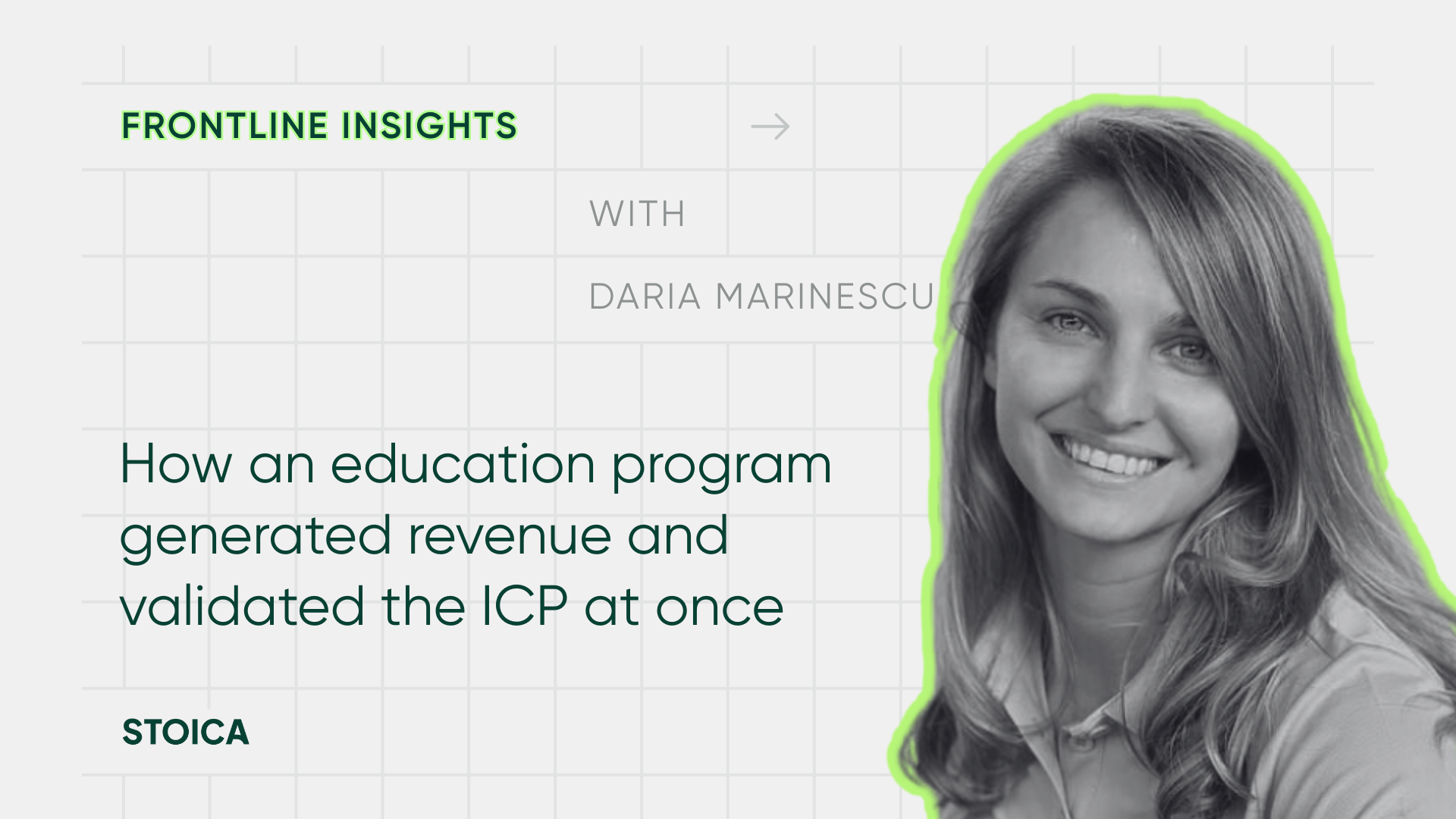
This conversation features Daria Marinescu, B2B Growth & GTM Strategist and CMO at Sferal AI.
With 20 years of experience at the intersection of strategy, research, and growth, Daria shares how an education program became a €250k/quarter revenue engine, why buyer self-service is reshaping pipelines, and what it takes to run a team where humans and AI agents work side-by-side.
The education program that changed everything
Last year, one strategy surprised Daria more than any other: a paid education program that generated €250k per quarter while participants used the product to learn.
People were eager to learn more about how to apply AI to real-world business workflows. Daria and her team took a chance and developed a structured program that was primarily promoted by their founder and the Termene database. The response exceeded expectations, but revenue was only one aspect.
The program became their richest source of strategic insight:
It provided data, content, positioning clarity, strategy direction, and product feedback on a scale that no other tactic could match. The education program proved to be an unexpected commercial and strategic growth engine. It became the quickest way to build trust, adoption, and a qualified pipeline long before they had the full product suite.
This approach extended to their other successful tactics: webinars focused on bottlenecks identified through observations and user interviews, founder-led content used as a distribution tool and intentionally promoted, ABM built on authentic ICP insights from the education program, events selected through careful research rather than random outreach, and executive visibility at international events aimed at sharing expertise rather than pitching products.
Buyers need guidance. Education is not enough anymore
The education program’s success revealed something even more important: buyer behavior was fundamentally shifting.
Daria observed a clear pattern throughout the year:
By the time someone raises their hand, they already know what they want to learn. If the company makes the shortlist, prospects come in warm and already in an active decision cycle.
This required a complete overhaul of their pipeline to adapt to a new reality: buyer self-service. They prioritized removing obstacles and providing clarity precisely when buyers need it most: instant booking, interactive demos, better distribution, and content designed to meet them where they already are.
The insight changed their entire approach:
Their bet for 2026 reflects this shift:
This will become a real differentiator because it takes effort, experience, and discipline to build this kind of pipeline. Most companies will still default to what’s easy: lightweight educational content. Daria’s team is betting on what’s harder but far more impactful.
Building an AI agents team (with the right rules)
Daria leads a team where humans and AI agents work together, and it has transformed everything. At the beginning of the year, her team was wasting hours on operational tasks. Even when they tried using ChatGPT, they spent more time prompting and fixing results than focusing on real strategic work.
So she built a team of AI Agents to take that load off. Initially, she believed agents would run smoothly once trained and connected to the right data. She was wrong:
That led to the rule they now live by: no owner, no agent. Every agent has a human owner responsible for performance and continuous improvement. It prevents automation drift and maintains high quality.
Her team of agents conducts market research, qualifies and enriches leads, handles personal assistant tasks, scores leads, analyzes feedback into insights, creates messaging variants from feedback, transforms support insights into articles, performs sentiment analysis, and identifies opportunities through content triggers for planning.
She’s discovered that building automations with AI agents speeds up the process by 4 times. Her toolkit includes Claude for reasoning and drafting, Sferal for building and monitoring multi-step AI agents, Perplexity for research, Lovable for creating briefs, and AI add-ons in Notion, Figma, and Miro for collaboration.
But 2026 brings a new evolution:
The triple skill set for 2026: business + technology + strategy
When asked about the most important skill for B2B marketing leaders right now, Daria identifies three interconnected dimensions:
You need to understand how revenue is generated, how unit economics work, and how to stay aligned with sales, product, and finance. Apart from that, you should understand what AI can and cannot do, as well as how to coordinate and integrate it into real-world workflows. And finally, strong strategic leadership is essential in a landscape where buyers educate themselves, automation is ubiquitous, and expectations for speed, clarity, and proof have shifted.
This shows how Daria balances long-term strategy with quick results. She builds systems that generate revenue while moving closer to product-market fit:
Every initiative has a dual purpose – it must teach something about ICP or the product, and it must create a visible commercial impact. The education program generated revenue while validating ICP. Founder-led content built brand trust while driving deals. ABM sharpened segmentation while opening conversations with the right accounts.
Instead of pursuing activities just for the sake of activity, she focuses on actions that generate momentum now, lessen uncertainty for the future, and establish repeatable systems rather than one-time victories.
When old playbooks stop working
Daria expects major changes to arrive faster than most companies are ready for. Automation can no longer be an afterthought. Buyers are entering the funnel much more self-educated and are using AI tools themselves, which means companies and marketing leaders must operate at that same level of clarity, speed, and technical fluency.
Leaders who only understand campaigns but not how to incorporate AI and automation into workflows will fall behind. Companies that delay automation will be overtaken by competitors who can deliver faster, cheaper, and with greater accuracy.
The distribution landscape is shifting in real time:
Relying on old acquisition channels without adapting will be a losing strategy.
The future belongs to teams that can integrate the machine aspects – AI, automation, and data orchestration – with the human elements: judgment, ethics, creativity, and narrative clarity.
Her advice is direct: stay curious, stay technical, and stay close to the market.
Stay close to customers. Read the LinkedIn comments, the Reddit threads, and the feedback loops. Watch how people evaluate products today: fast, self-guided, ungated, with very little patience for friction or fluff.
And don’t mistake activity for progress.
The experts who stay effective are the ones who prioritize learning, insight, and real impact over vanity activity.
Did you find this article insightful? Are you facing similar challenges?
Spread the word with other marketers on the front lines so they can learn from these insights, or at least breathe a sigh of relief, knowing they’re not the only ones navigating this chaos.
If you want to contribute and share your insights, reach out to us here or on LinkedIn.