Our “Frontline insights” series brings together perspectives from B2B marketing leaders who are navigating the industry’s challenges in real time. We’re exploring what’s working, what’s not, and how teams are adapting to economic uncertainty, shifting buyer behavior, and the latest technologies.
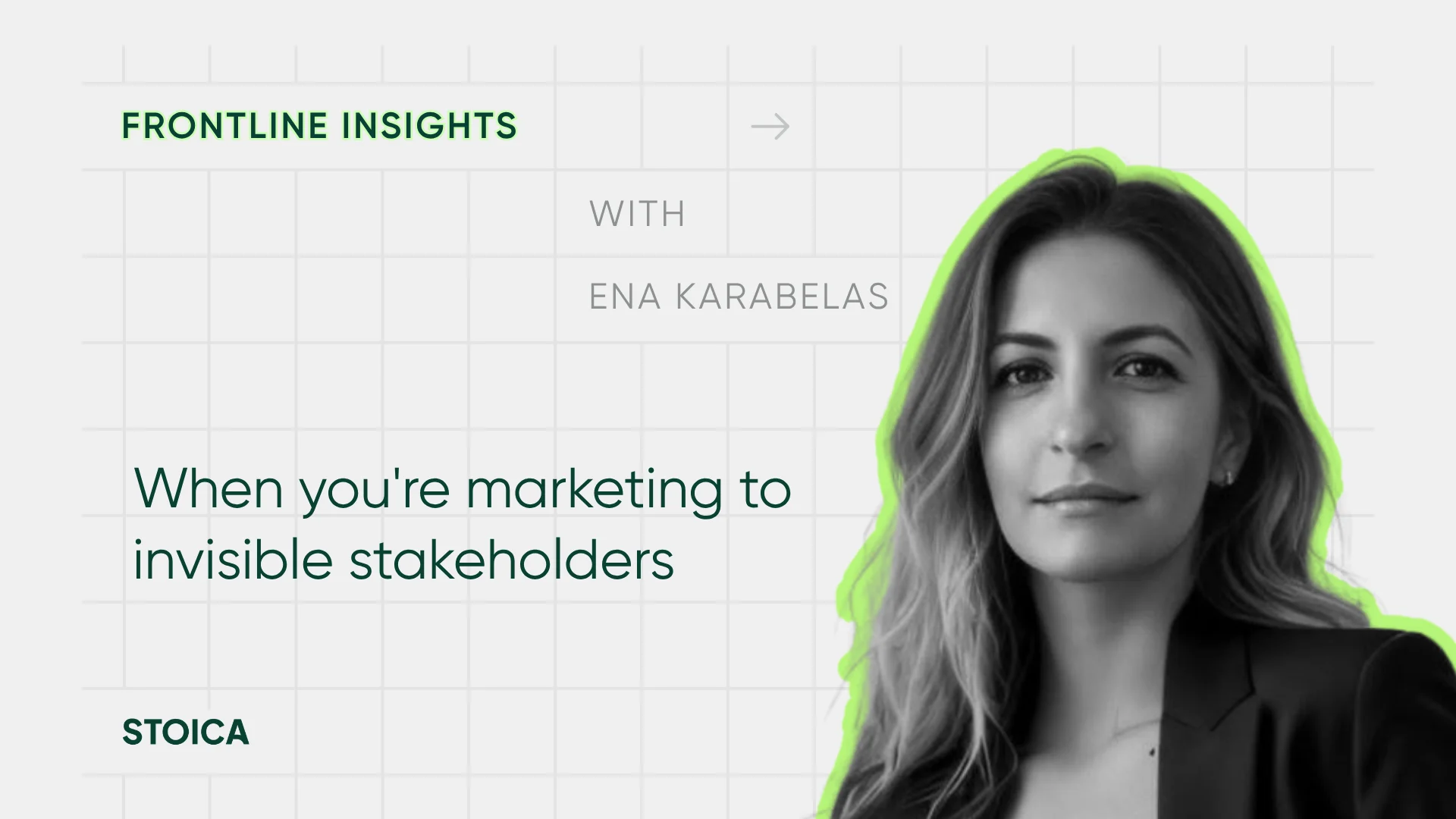
This conversation features Ena Karabelas, External Communications Manager for Europe, Middle East and Africa at Ericsson.
With over 18 years of experience shaping reputation and B2B marketing for global technology organizations, Ena shares why you’re no longer marketing to one buyer, how video translates complexity, and why sensemaking separates strong leaders from the rest.
Earning trust across invisible buying groups
Last year marked a shift for Ena’s work: moving away from “telling the market what we sell” toward building the conditions for knowledge-based trust. In complex B2B, buying teams have grown, stakeholders have expanded, and many people impacting final purchasing decisions are invisible in the actual sale and negotiation process.
You’re not trying to persuade one hero buyer in a single moment. You need to earn confidence across a group, and that takes time. When done properly, storytelling becomes a strategic tool for reducing perceived risk: it creates context, demonstrates credibility, and makes complex value tangible through evidence and narrative.
That strategic foundation led them to lean into executive thought leadership on LinkedIn, treating it less as a social channel and more as an ongoing trust-building platform. It became a way to articulate a point of view, share learning, and demonstrate competence with consistency.
It also allows speaking credibly to multiple stakeholders at once, with nuance, not just “here is what the technology can do,” but “here is why it matters, what the implications are, and how leaders should think about it.” That kind of content travels inside organizations and influences the hidden personas who may never engage with a product brochure or account managers, but absolutely shape the final decision.
The second tactic that performed well was integrated campaigns: a single, coherent story expressed through an intentional mix of touchpoints, each designed to play a role in the buyer journey. They start by grounding campaigns in customer reality, combining direct customer input, patterns from commercial teams, and market signals from research and competitive narrative.
This way, they are making sure that distribution is no just an afterthought. It ensures that the story reaches the full buying group in a way that is coherent, cumulative, and useful.”
Video helped with translating complexity into clarity
A positive surprise came from how well video formats have been performing.
By visualizing the customer situation and making the benefit obvious in seconds, they reduced cognitive effort for the audience. Video helped messages land faster, stay with people longer, and differentiate them in a still largely traditional B2B environment.
And it proved highly effective internally. Leaders connected with the format because it made the narrative easier to communicate and amplify. That executive pull significantly extended reach and strengthened results beyond what the same messages would typically achieve through more conventional formats.
Efficiency is driving sharper prioritization
The market environment remains uncertain all over the globe, bringing a stronger focus on efficiency across all marketing and communications activities. This has pushed a more deliberate, controlled approach to spending.
This disciplined approach is consistent with what other marketing leaders have described. The budgets were not necessarily smaller, but they were managed with much stricter expectations around impact and proof.
Today’s buyers are demanding credibility and proof
Ena has observed a wider shift toward more questioning, discerning buyer behavior, shaped by the same dynamics we see in everyday life.
As a result, clients are less tolerant of vague messaging and more attentive to credibility signals such as evidence, peer validation, delivery confidence, and outcomes framed in their language.
This shift connects directly back to the invisible stakeholder challenge. When buying groups expand and decisions become more collective, marketing must provide tools and narratives that travel through organizations, not just land with one contact.
AI as a productivity multiplier
In Ena’s day-to-day work, AI is primarily a productivity and quality multiplier. It helps her move faster from raw inputs to a clear storyline, sharpen messages for different stakeholders, and synthesize complex material into language that is usable for leadership communications and campaign execution.
A strong example is their “Make It Memorable” campaign, where they used AI as part of the creative development process to bring the idea to life in a cost-effective way. The work started from clear insights, including their own Ericsson ConsumerLab findings.
This approach demonstrates how AI can serve creative ambition when paired with strategic clarity and brand discipline. It accelerates execution and makes room for experimentation.
The real differentiators: sensemaking and narrative clarity
When asked about the most important skill for B2B marketing leaders right now, Ena identifies sensemaking paired with narrative clarity:
Data literacy is essential, but it’s not sufficient. What separates strong B2B leaders is judgment: selecting the few signals worth acting on, holding a coherent story across channels and markets, and expressing that story in a way that people can repeat, defend internally, and ultimately act on.
This philosophy shapes how Ena balances long-term strategy with the need for quick results. She treats it as a design problem: how to make short-term work accumulate into a long-term advantage.
Three shifts that are shaping the future
Looking ahead, Ena sees three shifts already taking form. First, AI-assisted personalization will raise expectations for relevance, while also increasing the penalty for anything that feels generic or untrustworthy.
Second, sustained differentiation through features alone will become harder, which will push more brands toward proof-based storytelling, where outcomes, delivery confidence, and measurable impact sit at the center of the narrative.
Third, owned influence will become more strategic. Executive voices, employee advocacy, and community-building will matter more as attention costs rise and platform dynamics continue to change.
Her advice for staying relevant reflects this future: treat it as a daily practice. Stay close to real customer tension by listening to what sales teams hear, where buying decisions stall, and what proof people ask for before they commit. Use AI to move faster on the mechanics, but keep human judgment in charge of accuracy, nuance, and credibility.
And invest in collaboration, because in complex B2B, alignment across marketing, communications, sales, product, and leadership is often the difference between a good idea and a result.
Did you find this article insightful? Are you facing similar challenges?
Spread the word with other marketers on the front lines so they can learn from these insights, or at least breathe a sigh of relief, knowing they’re not the only ones navigating this chaos.
If you want to contribute and share your insights, reach out to us here or on LinkedIn.