TLDR
- Technical foundation remains critical: Unblock AI crawlers, implement schema markup, and signal content freshness. Technical issues kill visibility regardless of content quality
- Brand mentions drive visibility: Off-site mentions show strong correlation with AI citations; focus on Reddit, review sites, and YouTube over traditional backlinks
- Structure content for extraction: Use question-based headers, BLUF formatting, tables, and statistics with dates—content organized this way is more likely to get cited
- Comparison pages are citation magnets: ICP-specific comparisons outperform generic content; create honest feature breakdowns with dynamic dates
- Measure authority, not clicks: Track citation quality across platforms; accept volatility and focus on patterns over time
Is LLM optimization really that different from SEO?
Yes and no.
LLM visibility is your brand’s ability to be discovered, cited, and recommended by AI systems like ChatGPT, Google AI Overviews, Perplexity, and Claude when users ask questions about your category.
The foundation is the same, but what you’re optimizing for has changed. Traditional SEO optimizes for clicks and rankings, while LLM visibility optimizes for citations and influence.
After 12 months of researching and experimenting with AI visibility strategies for our B2B tech clients, some patterns are emerging, and we’re going to discuss them in more detail in this article.
We’ve organized what’s working into five areas: technical accessibility, brand presence, content structure, topical depth, and measurement.
Before we move on, here’s the first pattern: AI-generated answers are volatile, where only 30% of brands remain visible consistently across LLM responses.
This article offers a much more thorough approach than our last article on the topic, but if you’re looking for a quick framework to get started, we shared two AI search action plans to help you get started.
Why technical foundation matters for LLM visibility
If your technical SEO isn’t airtight, nothing else matters because LLMs can’t cite what they can’t access.
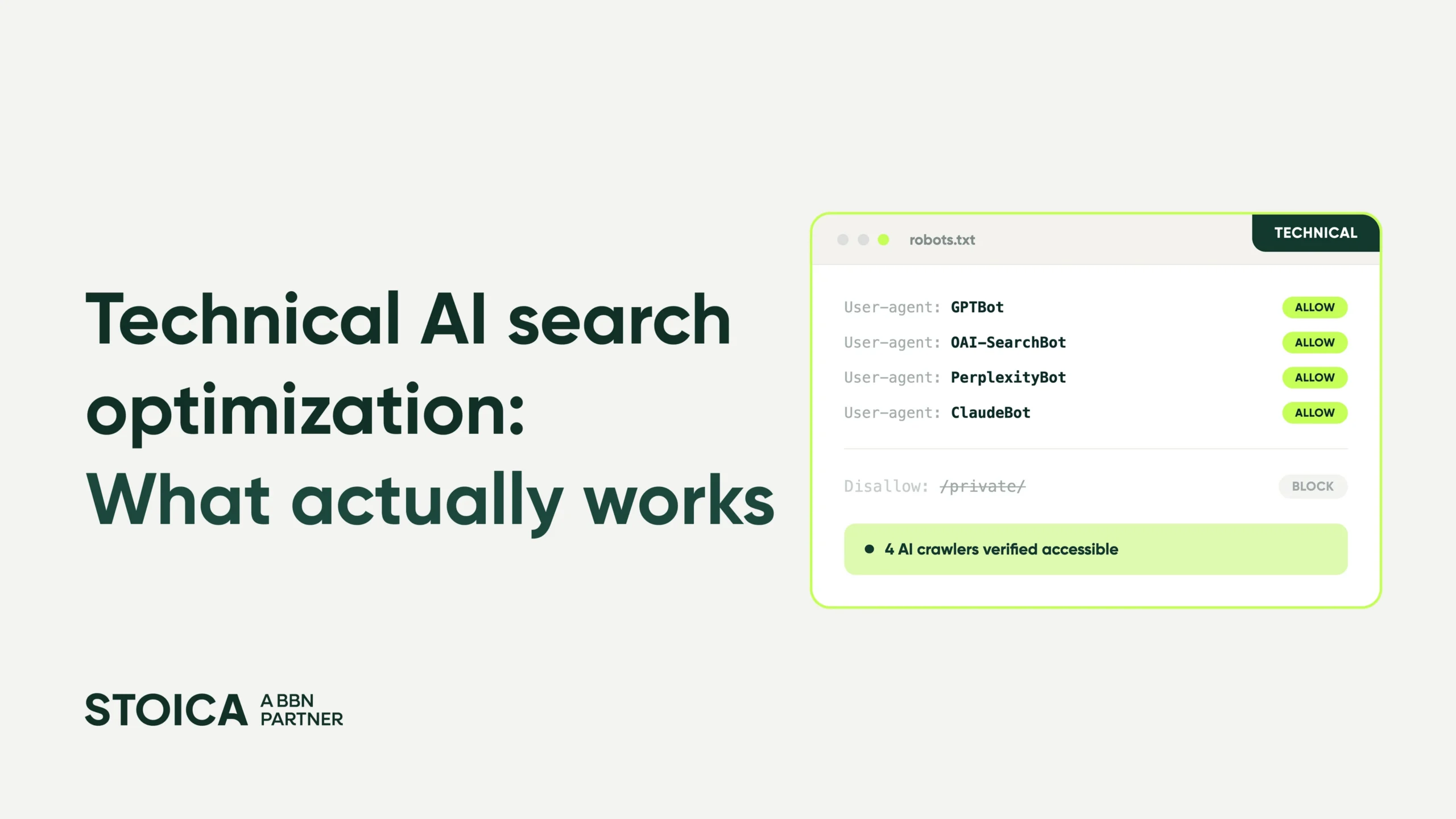
If your site blocks the crawlers popular LLM tools use — GPTBot, ClaudeBot, and similar — none of your content can be cited, no matter how good it is. This is one of the most common, and most fixable, mistakes we see. So, unblocking them is an important first step.
PRO TIP: Check your robots.txt file. Make sure you’re not blocking AI crawlers like GPTBot, ClaudeBot, or other LLM tools. This is the most common mistake that kills visibility.
Schema markup is also mandatory because the FAQ Page, Article, and HowTo schemas help LLMs understand and extract information properly and tell AI systems exactly what they’re looking for.
Semantic HTML structure matters too. Your heading hierarchy needs to be logical, as LLMs use this to understand how information connects.
Content freshness signals are critical as well. LLMs show a strong recency bias, especially those using real-time search.
Include explicit date indicators like “Last Updated,” and use IndexNow to notify Bing (which feeds ChatGPT) of content updates immediately.
Avoid JavaScript-dependent content. Most AI crawlers don’t render JavaScript, so crucial content embedded entirely in JS may be invisible to LLMs.
If you want to read more, check out this guide focused solely on technical AI search optimization.
How brand mentions drive LLM visibility
The single strongest factor for LLM visibility isn’t on your website. According to an Ahrefs analysis of 75,000 brands, branded web mentions showed a correlation of 0.67 with AI Overview visibility. This is the strongest correlation researchers found.
So, get mentioned frequently in relevant contexts across multiple sites, and LLMs will understand what your brand does and when to recommend you.
Target high-citation channels
Focus on getting mentioned on platforms LLMs trust: Reddit, Quora, review sites like G2 and Capterra, and YouTube transcripts. These channels carry disproportionate weight in how LLMs form opinions about brands.
Semrush analyzed 248,000 Reddit posts and found that the platform remains a leading source across all AI search tools: ChatGPT, Perplexity, and Google AI Mode.
Focus on mentions, rather than just links
According to the Ahrefs study mentioned above, the key shift from traditional SEO is that you don’t need backlinks for LLM visibility. The mention itself carries enough weight, so you should aim to be included in the conversation, with or without a link.
For most of us, this is refreshing. While it doesn’t make digital PR any easier, at least we will stop blindly chasing those “dofollow” links. For a while, at least.
Build brand recognition
Brand search volume is the most significant predictor of brand mentions in LLMs and AI tools. Work on building genuine brand recognition alongside your content efforts.
Your website needs crystal-clear positioning. Be extremely specific about who you are, what you do, and who you serve, while keeping that information structured for easy extraction.
Supporting pages matter for evaluation queries, too. Based on what you’re offering, focus on things like security documentation, integration details, and pricing transparency. LLMs reference these when answering comparison questions.
Key takeaway:
Off-site brand mentions show a 0.67 correlation with AI visibility, stronger than any on-site factor. Focus on: (1) Getting mentioned on high-citation channels like Reddit, G2, and YouTube, (2) Building mentions without requiring backlinks, (3) Ensuring consistent brand messaging across all mentions so LLMs can confidently associate you with specific topics.
How to structure your content for LLM citations
Classic SEO authority metrics (DA/DR/backlinks) aren’t direct predictors of AI citations. While they are essential, LLMs also reward other cues, such as clarity, structure, topical fit, and cross-web mentions.
So, a piece of content from a website with lower authority that is easier to extract and validate might win a citation over a high-authority site that buries information in dense paragraphs or lacks a clear structure.
Here’s how to approach your content for LLM citations:
Write comprehensive, in-depth content
Analysis of over 7,000 citations found that the top 10% of cited content had significantly higher word and sentence counts. Longer content offers more opportunities to answer the specific questions users ask LLMs.
Make it readable but thorough
Aim for good Flesch readability scores; easier-to-read content performs better while still being comprehensive.
Structure your content for easy extraction
Use bullet points, numbered lists, tables, and FAQs. Content organized this way is 28-40% more likely to be cited by LLMs.
Why does this work? Because LLMs are “lazy”. They want pre-chewed information they can quote directly.
Use question-based formatting
Structure content with question-based headings (H2/H3). Use the BLUF approach (Bottom Line Up Front), where the first sentence directly answers the question. This makes it easy for LLMs to extract quotable passages.
What also works is to include a table of contents, boxed definitions, key takeaway boxes where necessary, and FAQs. Treat every section of your content as a standalone piece.
Include verifiable evidence and data
Include concrete statistics with dates and years. Research shows that injecting specific statistics can boost impression scores by 28% on average. Every major claim needs a verifiable source. Quotes from subject matter experts are also meaningful.
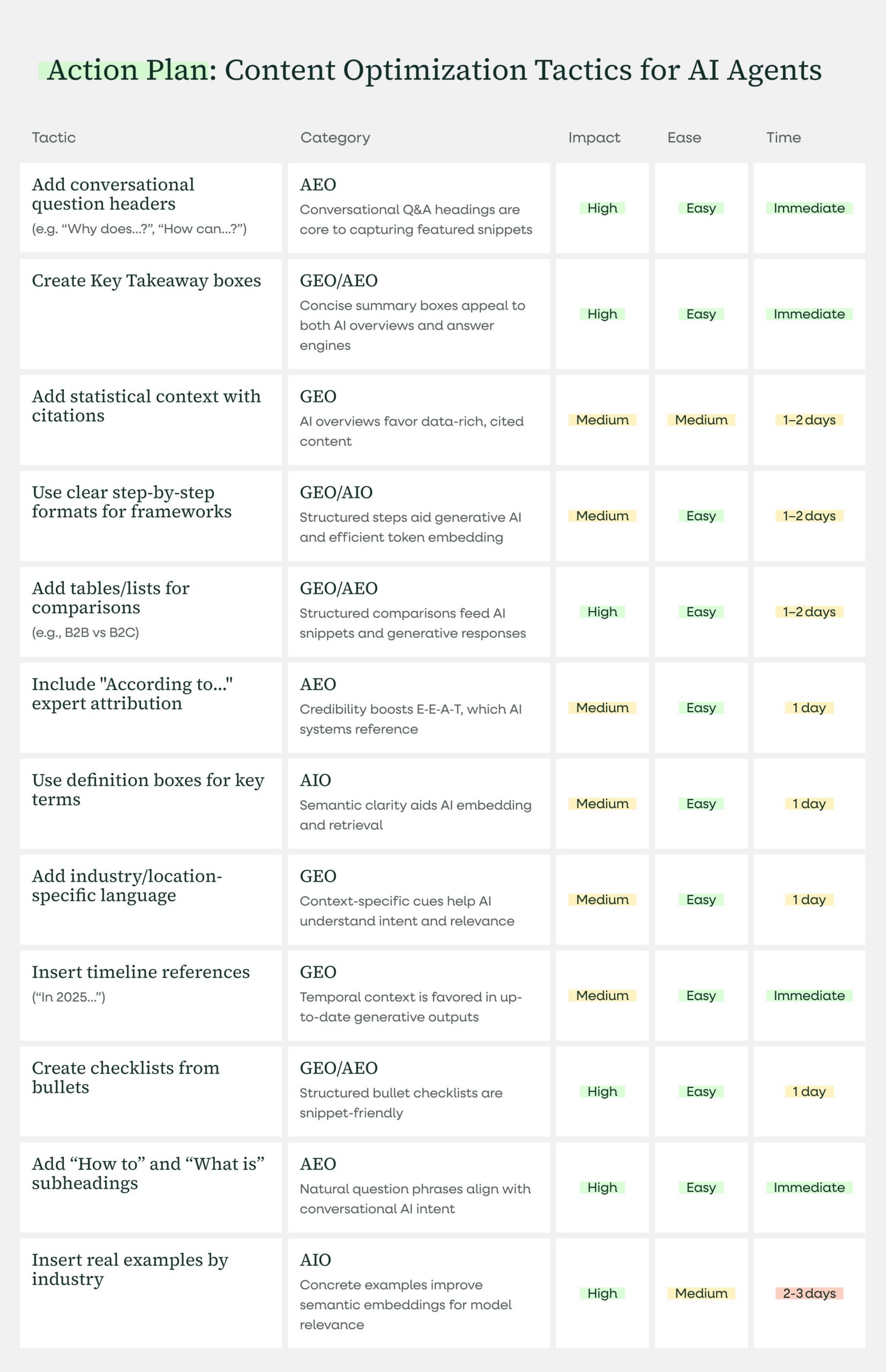
We created this action plan to help you get a complete view of how you need to structure your content for LLM citations. Download the full version here.
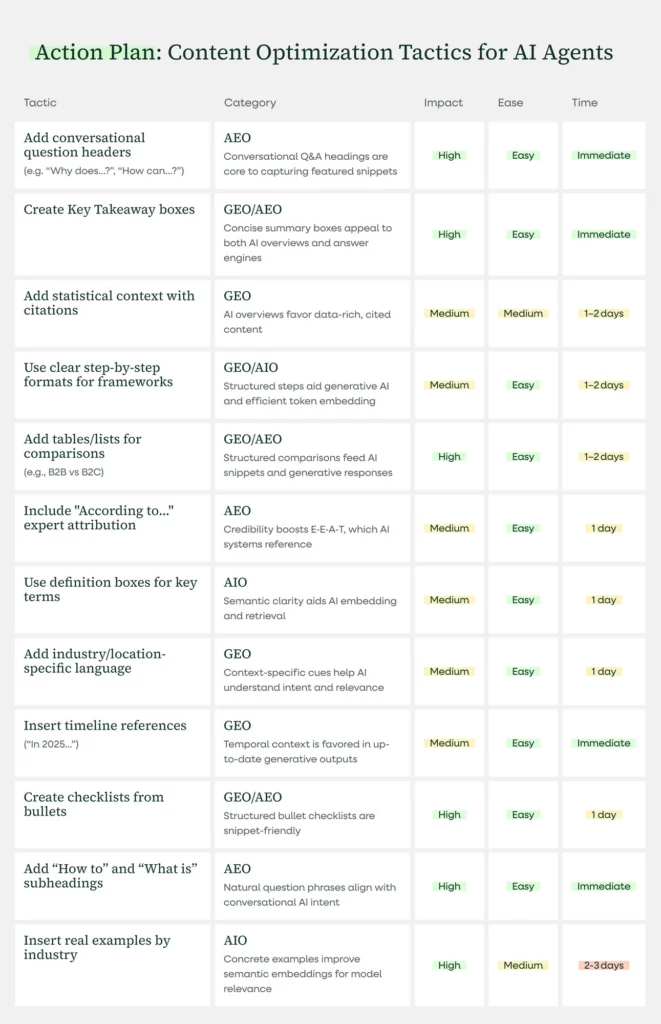
If you want to learn more, check out this detailed guide focused solely on structuring and optimizing your content for AI search engines.
How to build topical authority for GEO
Here’s where traditional SEO and LLM optimization diverge.
Start with high-intent comparison content
Comparison queries are high-intent, and LLMs actively look for these pages when answering evaluation questions. Create pages with competitor comparisons and alternatives that can be easily accessed and understood.
Build action-oriented use cases next
Action-oriented content showing how your solution applies in specific scenarios. These connect abstract concepts to practical application and link back to comparison content.
Add an educational foundation
“What is [topic]” and “How does [topic] work” pages fill out topical coverage. This is how LLMs learn to explain concepts.
Structure your case studies
Case studies and customer stories must also be structured for citation. Pull key metrics into scannable formats, use clear before/after frameworks, and tag by industry and use case.
Build your topic clusters
One 1,500-word article isn’t enough. You need content clusters: topic basics, topics for specific industries, topic vs. alternatives, common mistakes, and implementation guides. Related articles linked together help LLMs understand semantic relationships.
Get specific with your use cases.
Content for [use case] + [specific audience] combinations is more citable than generic content. “AI agents for sales teams” beats “AI agents.”
Why comparison pages matter for LLM visibility
Users constantly ask LLMs “which is better?” questions.
Comparison pages help LLMs reason efficiently, since you’re handing them the answer on a silver platter instead of making them extract information from multiple sites.
Create honest, feature-by-feature breakdowns. Show actual differences in capabilities, deployment options, pricing models, and ideal use cases. Don’t just list why you’re better.
Get specific with your ICP targeting. “AI agent platforms for financial services” outperform generic “AI agent platforms” on targeted queries.
Focus on specific features. “Conversational AI with omnichannel support for banking operations” may appear overly specific, but these long-tail comparisons are frequently cited when users ask detailed evaluation questions.
Include dynamic dates. “Best [category] tools – February 2026” signals freshness. Build two-way and three-way comparisons for competitors, both individually and in groups.
You can learn more about this approach from this insightful CXL video:
What to track for LLM visibility
You can’t optimize what you don’t measure. Instead of focusing on clicks, focus on the authority you’re building. Yes, we know that this may feel like trying to track ghosts, but the following signals will help you see the patterns you’re looking for:
Track inclusion percentage in answers
Create a set of questions/prompts that are relevant to your business and regularly test them across major platforms. At this point, you still have to do this manually. In tools like Semrush, you can see topics and prompts where you get mentioned, but we still haven’t found a way to track the ones we want specifically.
Track citation quality vs quantity
Brands that are both cited as a source AND explicitly mentioned in the generated answer are 40% more likely to resurface across runs compared to brands that are cited only. Having your company included in the answer shows the LLM is actively bringing your brand into the conversation.
Monitor share of voice
What percentage of relevant AI responses mention your brand compared to competitors? This provides essential competitive context.
Track across different platforms
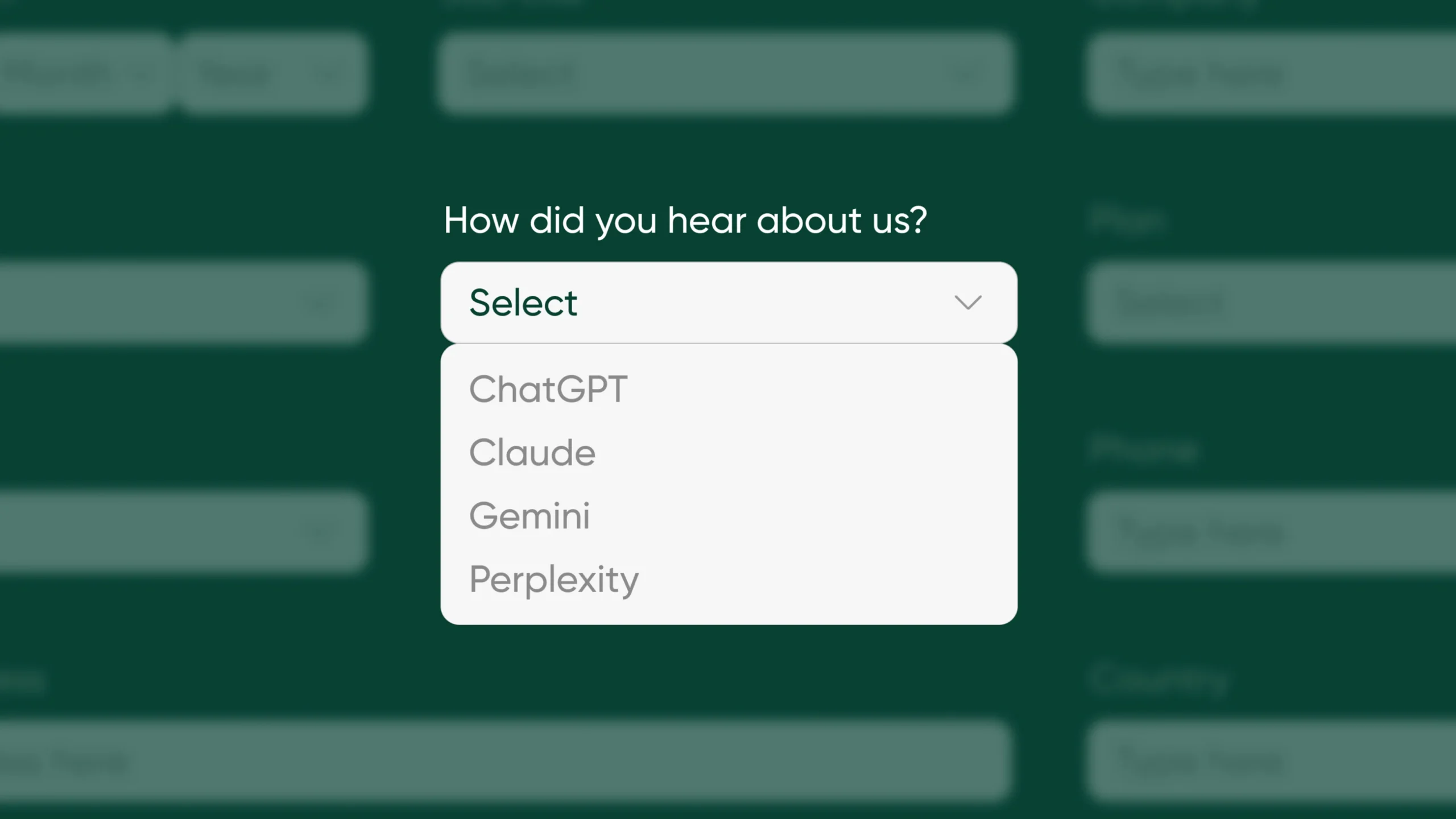
Different LLMs have distinct preferences. ChatGPT, Gemini, Claude, and Perplexity each weigh factors differently. What works for one might not work for another.
Monitor sentiment and business drivers
Tools like Semrush’s LLM Analytics let you track sentiment, business drivers, top-performing topics, and which pages have been referenced most often. Understanding these patterns helps you identify gaps where competitors dominate and where you need to focus content efforts.
Sentiment analysis shows how LLMs present your brand – positively, neutrally, or negatively -across different platforms.
Business drivers reveal which attributes LLMs associate with your brand most frequently. For example, you might discover LLMs emphasize your deployment flexibility but rarely mention your industry specialization, showing you exactly where to focus your efforts.
Top-performing topics identify which subject areas generate the most citations for your brand versus competitors.
Top-performing pages show which URLs get referenced most often and what makes them citable.
You should also be aware that, as we said at the beginning of the article, AI-generated answers are extremely volatile.
One client article we optimized ranked first in AI Overviews for its target keyword. Then they dropped out. Then reappeared. This is completely normal.
Now that you know what to build and how to measure it, here’s the practical question: where do you actually start?
Key Takeaway
Shift from measuring clicks to measuring authority. Track citation quality over quantity, because brands that are both cited AND mentioned in the answer are 40% more likely to resurface consistently. Accept volatility as normal—only 30% of brands stay visible in consecutive responses—and focus on patterns over time, not day-to-day fluctuations.
Where to start with your LLM visibility strategy
If you’re starting from zero, here’s a 10-step checklist:
- Check robots.txt and unblock AI crawlers (GPTBot, ClaudeBot, etc.)
- Implement FAQPage, Article, and HowTo schema markup on key content
- Add “Last Updated” dates and set up IndexNow for content updates
- Ensure crystal-clear brand positioning on your website (who, what, for whom)
- Target high-citation channels (Reddit, Quora, G2, YouTube) for brand mentions
- Restructure content with question-based headers and BLUF formatting
- Add extraction-friendly elements (bullet points, tables, FAQs, statistics with dates)
- Create comparison pages for top competitors with ICP-specific variations
- Build topic clusters covering use cases, educational content, and case studies
- Set up tracking for core prompts across ChatGPT, Gemini, Claude, and Perplexity
PRO TIP: The principle remains: build authority through repeated, contextual mentions across the web. Your owned content establishes depth. Your presence in non-owned spaces establishes credibility. Before getting started, make sure these visibility goals are aligned with your marketing strategy.
What we’re still figuring out about LLM visibility
How much does freshness actually matter by topic? We see recency signals, but the impact varies wildly.
What’s the threshold for “comprehensive enough”? How deep is deep enough to establish topical authority?
Do certain content formats (video transcripts, podcasts) carry a different weight than traditional articles?
How do you optimize for multiple LLM platforms when their preferences diverge? Which ones should you focus on?
The volatility is real.
Citation patterns are probabilistic by design. But the fundamentals: technical excellence, brand clarity across touchpoints, comprehensive content, comparison ownership, and systematic measurement seem to hold regardless of how the landscape shifts.
The field is still evolving. We’re documenting what works, adjusting when it doesn’t, and staying honest about what we don’t know yet.
If you want your brand to show up in AI-generated answers, whether that’s Google AI Overviews or tools like ChatGPT and Perplexity, so clients can find you when evaluating options, let’s chat !