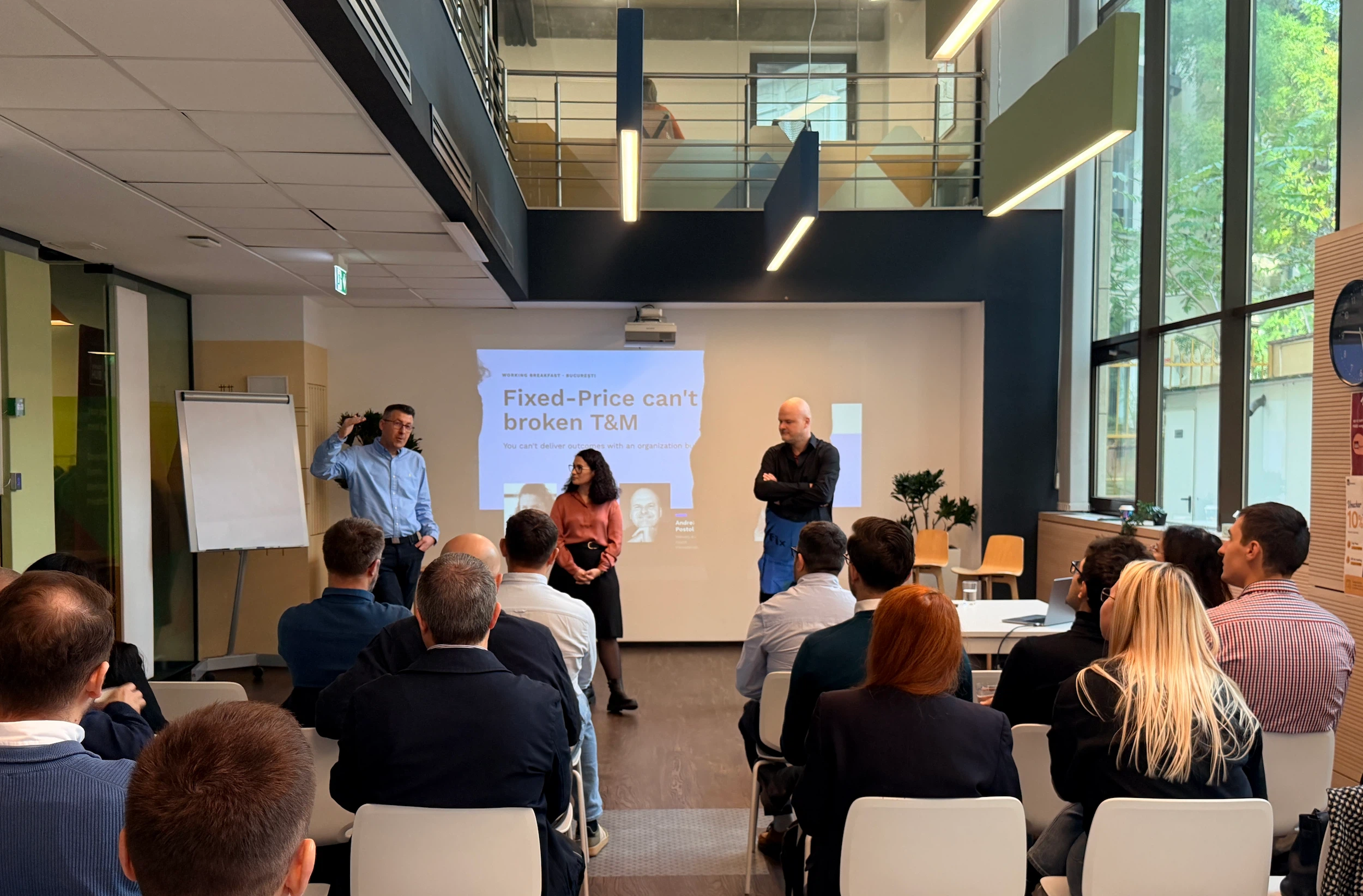
I went to the “Fixed-price can’t fix broken T&M” session with 2 things in mind. To make sure the working breakfast ran smoothly and to listen.
The room was full of people from B2B software companies, the kind we like to work with, and I wanted to hear what they’re struggling with right now.
I expected to take notes for our clients or for the follow-ups after the event.
Then, one of the speakers said something I related to very strongly, and by the end of the morning I had a list of things to change at our agency. Read this article if your team keeps getting faster with AI, but your invoices still count hours or effort, and you want to price on the value you deliver instead.
We co-hosted the morning with people who know this topic from the inside. Emanuel Martonca, founder of Soft Fight, is a pricing engineer who has negotiated 340+ tech services deals. Andrei Postolache, Organizational Consultant & Leadership Coach at Introspecials, spent more than two decades in software services and ran Endava’s 300-person Iași unit. Elena Stoica, our Head of Growth, worked in sales and operations at Stefanini before moving into marketing, and spoke about positioning. More than 60 people registered.
The better you deliver, the less you bill
Emanuel opened with what he calls the AI Efficiency Trap.
For two decades, effort and value moved together, so billing for hours was a fair proxy for billing for value.
AI breaks that link.
A team on time-and-materials (T&M) that delivers faster with AI either earns less for the same result, or hides the efficiency and risks the client’s trust. As he put it in a post after the event: you sell efficiency, but you bill time.
That’s the line that stung. At STOICA, we’ve had our own version of this conversation over the years, every time a tool or a better process made our work faster while our pricing stayed the same.
Spoiler alert: Fixed price doesn’t solve it either.
The reason is that many fixed-price projects are still calculated from effort estimates, so the contract changes its label and the price still starts from hours. One attendee put the everyday version of it plainly:
“Our businesses always live with the tension between what you quote and what it costs you.”
29 criteria and no recipe
Emanuel’s way out is to change the lens: ask what the client is buying, not how many hours the work takes, and price each layer on a different driver.
| Layer | What it requires | What drives the price |
| Inputs | Resource capacity | Effort, time, materials, tokens, licenses |
| Outputs | Scope clarity | Fixed scope, releases, AI test suites and agent setups (evals, harnesses) |
| Outcomes | A value model, defined metrics | Results, success criteria written into the SOW |
| Performance-aligned incentives | Impact attribution, autonomy | Economic value, ROI, downside avoided (gain-share, pain-share, SLA) |
Each step up pays better, and there’s no formula for choosing.
You need a mix of pricing models. I don’t think there’s a recipe anymore. I’ve documented 29 criteria. (…) The first step is accepting that we need a model where we take on more risk.
”His advice for where to start fits on one slide:
To start and have a big impact, start with one thing: give 2 options. Not only in the commercial offer. Also in how your team can solve the problem in two different ways.
”Being more useful than a well-documented AI
Andrei took us from the contract to the organization behind it, starting with why the advantages that built Romanian software services are losing their weight.
Our industry grew fast because we had universities training qualified people, there was demand, and we had a good reputation as Europeans who solve your problem. With AI, you no longer need as many qualified people. Technical skills become irrelevant when AI can solve the problem, and there’s no point talking about low costs anymore.
”What Romanian software services usually didn’t have was domain expertise, marketing, sales, and product thinking. They were optional while demand was high and “headquarters” took care of them. His example of what changes when a company has them:
We need to understand our clients’ industry and business much better. One client we worked with builds software for the maritime industry. Their proposals didn’t contain a single technical word. They focused on what the client could achieve by working with them, and on the outcomes they could get under different collaboration models.
”This is the advice I resonate with most, because your buyers already have a well-documented assistant. In G2’s 2026 AI Search Insight Report, based on a survey of more than 1,000 B2B software buyers, 51% said they start their research with an AI assistant more often than with Google. AI assistants are now the top source influencing which vendors make the shortlist (54%, ahead of software review sites at 43%), and 69% said AI led them to a different vendor than they had planned.
What the assistant can’t give your client is someone who knows their industry, their margins, and their customers well enough to promise a result and stand behind it. That depth is what keeps you more valuable than a resourceful AI, and it’s what makes pricing on value possible. You can’t price an outcome you don’t understand.
It also changes who you hire. Andrei asked every leadership team what their superstar looks like now: an outcome-oriented player-coach who makes pragmatic decisions when things are unclear. A participant pushed back right away:
“Only a few people can have the superstar profile. At the same time, we see corporations laying off more and more people. How do we find the right people?”
Emanuel answered pretty quickly and reminded us all that the superstar shouldn’t be thought of as a single hire:
The profile Andrei described may be the unicorn, but it doesn’t have to be one person. It can be assisted by agents.
”Andrei wrote in a LinkedIn post about one mindset that has to change in Romanian IT. He called the people who have it “cathedral builders”: they want everything they build to be perfect and to last for decades. But most software today changes many times and gets replaced within a few years. What’s needed now is something quick to put up and easy to change. In his words: “pontoon bridges, not cathedrals”.
Where positioning comes in
Elena’s talk reinforced what I tell our clients too: you can’t price on value until you know who you serve best and what they value in you. Positioning is where most of our client work starts at STOICA, and we turned what we learned over the years into a guide to brand positioning for B2B tech companies.
Many software services companies skip a basic question: what do you want clients to know you for? Positioning means knowing how you’re different and what the client values in you compared with the alternatives. (…) Before any campaign, you need to know where you play: who your best customer is and why you’re the best fit to serve them.
”Without that clarity, an outcome-based contract risks becoming a fixed price with a different name.
The list I brought back
The attendees we spoke with were candid. One said, “The present still looks good, but we know nothing about the future.” Another participant mentioned: “Everyone is relatively panicked and asking questions, trying to find solutions, but there’s still no path we can see clearly in front of us.”
Nobody left with a recipe, and neither did I. I left with a list we’ve started working through at STOICA:
- Send two options in every proposal, including two ways of solving the problem.
- Look at the projects we still price from the effort we estimate, and ask what the result is worth to the client.
- Go deeper into the industries and businesses of the clients we serve.
- Decide which risks we’re willing to share with a client, and price them in.
None of these is specific to software.
If you sell expertise of any kind, start with the question that stayed with me on the way home: if your team became 30% more efficient with AI tomorrow, would your revenue go up or down?
It was one of the best events I’ve been to this year.
You may know some of these ideas already. I knew a few of them too. Hearing them from people who speak from their own experience is what moves you from knowing a principle to acting on it.
Continue the conversation
Our next event is on the 26th of November, on Zoom, where we’ll cover how to define your market and positioning, how to use buying signals to prioritize accounts for sales, and what we’ve learned from recent client experiments, followed by an open Q&A. Register here.
If you want to go deeper on pricing, Emanuel and Andrei turned the discussion into a one-day workshop for management teams, From T&M to Outcomes in software & IT services. You can reach them on LinkedIn to learn more: Emanuel Martonca and Andrei Postolache.
Whichever conversation you join next, here’s one question to take with you: if your best client had to describe the value you bring without mentioning hours, team size, or technology, what would they say?