If your marketing results feel inconsistent, the problem is rarely the channel or the content; it’s usually your brand positioning.
In B2B, companies stall when they can’t clearly articulate who they serve, what they stand for, or why they’re the better choice. And when this clarity is missing, the impact is felt everywhere – in messaging, campaigns, conversion rates, and even pricing power.
The data is hard to ignore:
- Up to 90% of B2B deals are won by brands that come to mind first.
- Only 5% of buyers are ready to purchase now; the other 95% decide based on the impression you’ve already created.
- Companies with strong positioning see up to 50% higher marketing effectiveness.
- Differentiated brands command 10–13% higher prices with less pushback.
Brand positioning is not a creative exercise. It’s a commercial one. It shapes how much attention you earn, how fast prospects trust you, and how predictably you grow.
Rodger Jones, Director of Brand Strategy at Bader Rutter, captures it well:
The key challenges B2B marketers face have grown in magnitude today: technological change, globalization, commoditization, and competitive differentiation. These challenges make having a strong, foundational brand strategy more relevant than ever.
”We see it often: teams publish content, launch campaigns, and host events, yet performance still lags behind effort. The problem is that prospects can’t quickly distinguish the brand from competitors, so it never makes their shortlist.
When positioning becomes clear and differentiated, prioritization becomes easier, messaging sharpens, and growth becomes more predictable.
Action to take: Ask your team, “Would we all describe our value the same way?”
If not, that’s your first sign that positioning needs attention.
What brand positioning really is (and why it matters more than people think)
Most people imagine brand positioning as a polished sentence you craft during a rebrand.
A one-liner to include on the homepage of a newly designed website. Or on your social media profile.
But is brand positioning limited to that?
Positioning is the space you intentionally choose to own in your buyer’s mind. A simple, memorable idea that answers four questions:
- What you do
- Who it’s for
- Why it matters
- Why you’re the better choice
Here’s the part most teams overlook:
Positioning is about focus. It’s deciding what you won’t say, so the things that matter can land. As Rodger says:
Brand planning is about giving up, not adding. When you have a doubt, please leave it out.
”Good positioning removes noise. It gives teams a filter for sharper, more consistent decisions.
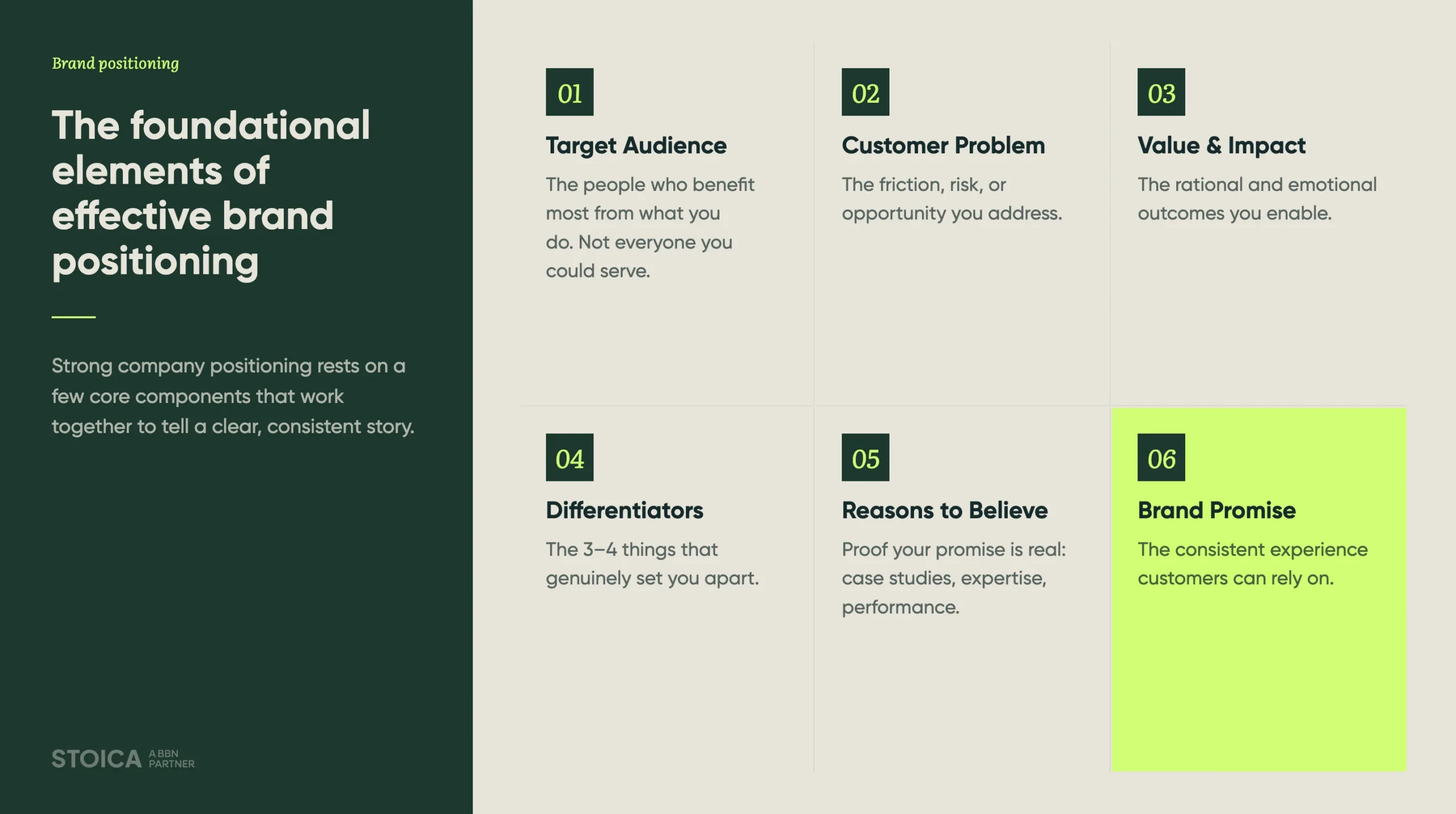
Strong organizations use these components as an internal GPS for every campaign, pitch, and decision.
Many businesses try to invent their positioning from scratch.
The best ones uncover it by listening to their customers, watching how the market shifts, and being honest about what they actually do best.
If you want your positioning to stick, it needs to feel true before it feels clever.
Action you can take: Start by gathering insights rather than jumping into writing. Ask your best clients, “What made you choose us, and what keeps you with us?” Their responses reveal the truth that your positioning should be based on.
When the brand positioning statement becomes your internal compass
A brand positioning statement is not a public slogan. It’s an internal alignment tool that clarifies the essentials:
- Who it’s for
- The category you operate in
- What makes you different
- Why people should believe you
- The outcome you create
Here is the Brand Asset Management (BAM) template we use with clients:
For [target audience], [Brand] is the [frame of reference] that [core benefit/differentiator], because [proof/reason to believe], so that [emotional or business outcome].
And here is our example of a brand positioning statement:
“For B2B companies looking to scale, STOICA is the marketing partner that helps them reach the right buyers with the right message because we bring research, strategy, and hands-on execution together so they can grow with clarity and predictable systems.”
The value of a positioning statement is not in how creative it sounds but in how clearly it helps teams make consistent, confident choices.
Action you can take: Draft 1–2 versions and ask, “Could a competitor say this?” If yes, refine.
Brand Positioning vs. Unique Value Proposition vs. Brand Identity
These terms often get mixed up. They work together, but they are not the same. Understanding the difference helps teams make better decisions and stay consistent across campaigns, content, and design.
Here’s the simplest way to think about it:
Brand Positioning – the idea you want to own
What it defines:
- The space you occupy in your customer’s mind
- Who you serve
- Why are you different
- The outcome you help them achieve
In practice, brand positioning answers the question of why a buyer should choose you over someone else.
Example:
A cybersecurity company positions itself as “the fastest way for mid-market teams to secure their infrastructure without enterprise complexity.”
Important to remember: Positioning is strategic. It guides decisions, not copywriting.
Brand Message (Unique Value Proposition) – how you express that idea
What it defines:
- The core message you want buyers to remember
- The promise you make
- The immediate value you highlight in campaigns or sales conversations
Your unique value proposition (UVP) translates the strategy (positioning) into a message someone can quickly understand and remember.
In practice, if positioning is the strategic truth, messaging is the day-to-day language you use to communicate it.
Example (building on the cybersecurity example above):
“Secure your infrastructure in days, not months.”
This is not positioning; it is the message derived from it.
Important to remember: Messaging can evolve quickly. Positioning should not.
Brand Identity – how the idea looks, feels, and sounds
What it defines:
- Visual identity (logo, colors, typography, layouts)
- Tone of voice
- Website design
- Marketing materials
- Photography and illustration style
Identity expresses your positioning visually and verbally.
In practice, if positioning defines who you are, identity shows what that looks like.
Example:
A brand focused on “speed and clarity” might use minimalist layouts, crisp language, and fast UX.
Important to remember: A rebrand won’t fix weak positioning. Identity must express a strategy, not replace it.
Bringing it all together: Druid AI’s case
When we worked with DRUID, a fast-growing AI company, their challenge wasn’t aesthetics; it was clarity. The business had evolved; the brand story hadn’t. Using the BAM framework, we aligned positioning, messaging, and identity so the brand finally reflected the company’s direction.
Only when the foundation was aligned did the rebrand create the impact they expected.
Action you can take: If you’re unsure what’s broken, ask:
- Are we struggling with what to say? → positioning
- Are we struggling with how to say it? → messaging
- Does everything feel misaligned? → identity
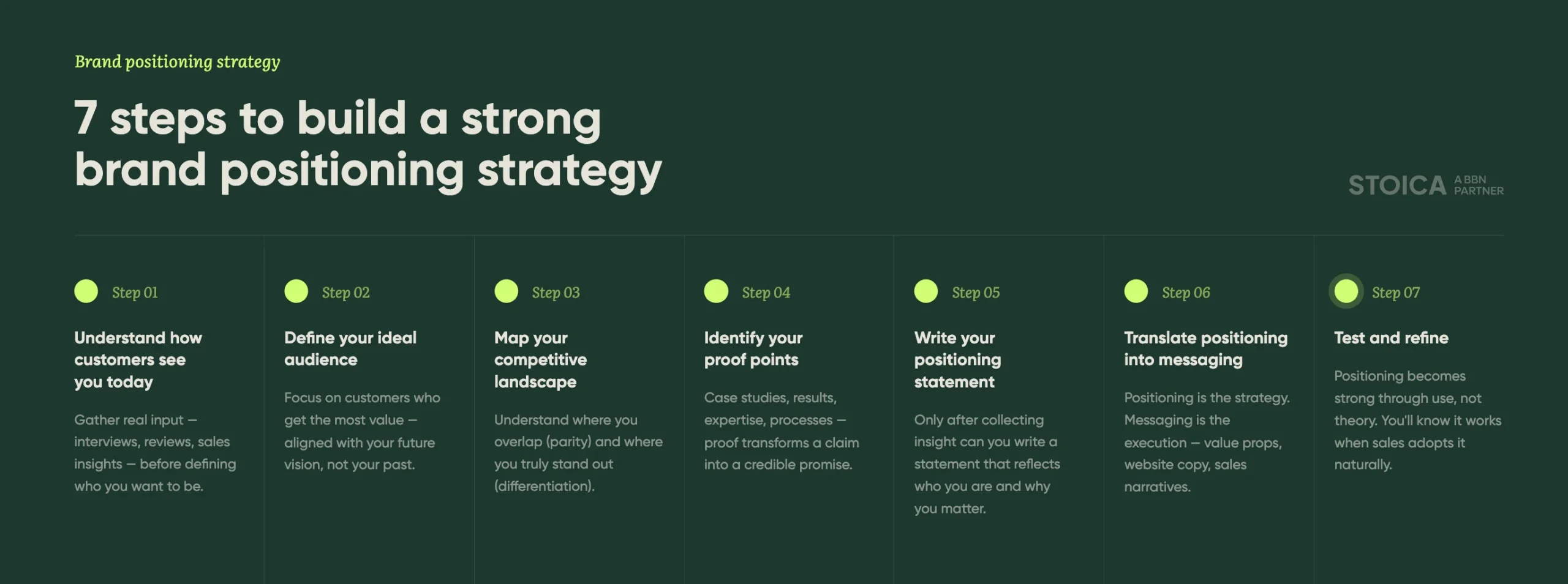
7 steps to build a strong brand positioning strategy
A strong brand positioning strategy isn’t created in a single workshop or brainstorm. It’s built through a structured process that uncovers how your brand is perceived today, what makes it valuable, and how it should evolve to support growth.
Here are the essential steps we follow with clients:
1. Understand how customers see you today
Before defining who you want to be, you need clarity on who you already are.
Look beyond assumptions and gather real input:
- Customer interviews
- Sales insights
- Reviews, demos, support questions
- Competitive conversations
For one of our clients, we ran a Perception–Reality exercise to compare their current image with the future identity they wanted to build. This revealed specific gaps and opportunities that shaped the new positioning.
Action to take: Collect 10–15 answers from real customers. They often describe your true differentiators more clearly than you do internally.
2. Define your ideal audience
Positioning fails when it tries to speak to everyone. Your brand positioning strategy should focus on:
- The customers who get the most value from you
- The ones you want more of
- The segments aligned with your future vision, not your past one
In our strategic workshops, we use a Target Audience Map to prioritize the buyers who matter most, aligning leadership, marketing, and product.
Action to take: Identify your “best-fit segments” and write a simple statement:
“We create the most value for ___ because ___.”
3. Map your competitive landscape
The goal isn’t to copy competitors; it’s to understand:
- Where you overlap (parity)
- Where you truly stand out (differentiation)
Using BAM’s parity/differentiation mapping, teams quickly see what is unique and what is generic.
Action to take: List 3–5 areas where you differ from competitors, and validate if customers agree.
4. Identify your proof points
Positioning is only as strong as the evidence behind it. Your credibility comes from what you can prove, not just what you claim.
Your most convincing proof is found in:
- Case studies
- Repeatable results
- Expertise
- Processes
- Testimonials
- Capabilities
This is what transforms a claim into a credible promise. Using the Offering Profile, we clarified DRUID’s features, advantages, and benefits, then linked them to concrete outcomes that matter to enterprise buyers.
Action to take: Document the customer results, product strengths, and success stories that reinforce your differentiation. List your top 5 pieces of evidence that no competitor can easily replicate.
5. Write your positioning statement
Only after collecting insight can you write a statement that reflects who you are and why you matter.
In the example cited, we distilled the workshops’ results – specifically the Desired Identity, Club Statement, and Targeted Proposition – into a unified strategic statement that now serves as the foundation for our client’s branding, messaging, and website efforts.
Action to take: Draft 2–3 versions and review them with sales, product, and leadership. Look for alignment, not perfection.
6. Translate the positioning into messaging
Remember what I previously said: Positioning is the strategy; messaging is the execution.
This is where you turn the statement into:
- Value propositions
- Website messaging
- Sales narratives
- Campaign themes
You can structure your messaging using the Message Matrix, so each target audience receives the right value proposition and supporting messages.
Action to take: Build a short messaging guide with 3–5 key messages that reinforce your core positioning.
7. Test and refine
Never forget that positioning becomes strong through use, not theory. You’ll know it works when:
- Sales adopts it naturally
- Buyers repeat it back to you
- Content feels easier to create
- Campaigns convert more consistently
For our client, we validated the new positioning with stakeholders and used early messaging tests to refine tone and emphasis before finalizing identity and website direction.
Action to take: Test your messaging in real conversations or landing pages. Look for what resonates, what confuses, and what gets ignored.
When and why you should consider repositioning
You know it’s time to revisit your positioning when:
1. Your business has evolved, but your brand hasn’t. Shifts in product, markets, or strategy create a natural gap between who you were and who you are becoming. When customers still associate you with your “old self,” it’s time to reposition.
2. Customers struggle to see what makes you different. If prospects confuse you with competitors or can’t articulate why they should choose you, your positioning is no longer meaningful or differentiated.
3. Your ideal audience has changed. Growth often comes with new markets, new segments, or a sharper focus. When your positioning still speaks to yesterday’s buyer, it stops attracting the right one.
4. Teams tell different versions of the story. If sales, marketing, and leadership describe your value in inconsistent ways, the positioning is no longer providing the alignment it should.
5. Your brand limits your ambitions. When your current narrative feels too narrow, too generic, or misaligned with where you want the business to go, repositioning becomes a strategic enabler rather than a cosmetic exercise.
Action to take: Ask customers and your team, “Why would someone choose us?” If the answers don’t match, repositioning is overdue.
Rebranding without losing SEO visibility (Checklist)
Rebranding often involves updating your website or migrating to a new domain. Done well, you keep your SEO equity intact. Done poorly, you risk losing rankings, traffic, and hard-earned visibility. Use this checklist to do it right:
1. Create a complete redirect map (301 redirects) – List every URL on your old site and map each one to the correct new URL. Implement 301 redirects before launch to ensure all existing authority carries over.
2. Submit your updated sitemap in Google Search Console – Generate and upload the new sitemap as soon as your site goes live. This helps Google recrawl your pages faster.
3. Use Google’s “Change of Address” tool – Verify both domains in Search Console, then submit the request. This step is essential when migrating to a new website domain after rebranding.
4. Audit backlinks and internal links – Use tools like SEMrush or Ahrefs to identify your most valuable backlinks and ensure they point to your new URLs. Check internal links as well and update any that still reference the old domain.
5. Monitor performance for the next 4–8 weeks – Watch for indexing errors, missing redirects, or sudden drops in organic traffic. Fix issues quickly to prevent long-term impact.
Handled correctly, a rebrand doesn’t have to harm SEO. With this checklist in place, you can protect your visibility while giving your brand the fresh identity it needs.
Brand positioning is not a tagline – it’s the strategic foundation that determines whether your marketing compounds or gets ignored.
If you want help defining or refreshing your positioning, shaping your brand narrative, or aligning your identity with your growth strategy, we’d be happy to support you.
Explore our work, read about our approach in practice, or reach out for a strategy conversation.
Frequently asked questions about B2B brand positioning
What’s the difference between brand positioning, messaging, and brand identity?
Positioning is the idea you want to own. It’s strategic and shouldn’t change often. Messaging (or your unique value proposition) is how you express that idea in words buyers can repeat back. Identity is how it looks, sounds, and feels across your website, visuals, and tone of voice. A rebrand can refresh identity, but it can’t fix positioning that was never clear to begin with.
What is a brand positioning statement, and how long should it be?
A brand positioning statement is an internal alignment tool, not a public slogan — it names your audience, your category, your differentiator, your proof, and the outcome you create, usually in a single sentence. Length matters less than clarity: if your team can’t repeat it consistently, it’s doing too much.
Why does brand positioning matter for B2B tech companies specifically?
Because most B2B buyers have already formed an impression before they ever talk to sales, so positioning is what shapes that impression while you’re not in the room. In crowded, commoditized tech categories, unclear positioning is usually why marketing effort and results don’t match.
How do you know when it’s time to reposition?
The clearest signal is a gap between who you were and who you’ve become, especially if your product or market has moved on, but the story hasn’t. Other signs: prospects can’t say what makes you different, or your own team describes your value in inconsistent ways.