TLDR
- AI search selects passages, not pages. Structure determines whether your content gets cited, not just indexed.
- Accessibility and authority both matter. Content that's easy to extract but generic won't get cited; content that's authoritative but poorly structured won't get found.
- Answer first, explain second. Every section should open with a direct response to the question its heading raises.
- Original insight is still your biggest differentiator. AI can summarize the web; it can't replicate your experience, data, or judgment.
There’s no shortage of advice on how to optimize and structure your content for AI search engines, as well as for other aspects of GEO, AEO, AIO, whatever you want to call it. Some of it is good, some of it contradicts itself, and new data keeps emerging. What we know today looks different from what we knew six months ago, and in a couple more months, we’ll probably know so much more.
What we do have is a growing set of things that have worked, either in our own content and in the work we do with our B2B tech clients. That’s why we decided to show you our process: how we approach research, how we structure content for AI extraction, and what makes the difference between content that gets indexed and content that also gets cited.
This article focuses on content alone, but if you’re looking at the full picture (brand mentions, technical setup, and measurement), we cover all of that in our guide to LLM visibility optimization.
How did AI search change the content optimization process?
In May 2026, Google published an official guide stating that GEO and AEO are, essentially, still SEO, and that tactics like content chunking, llms.txt files, and AI-specific schema aren’t necessary for visibility in their systems. They’re right. For Google.
The problem is that Google’s guide only describes Google’s system. Only 12% of URLs cited by ChatGPT rank in Google’s top 10 for the original prompt. Perplexity runs its own index with a strong freshness bias. ChatGPT pulls heavily from Bing and favors Wikipedia, Reddit, YouTube and LinkedIn as citation sources. One platform’s best practice is another platform’s irrelevant signal.
Here’s how we actually see it: SEO fundamentals are the foundation for all platforms. But above that foundation, each AI system has distinct preferences, and structuring content to be extractable, modular, and authoritative matters significantly for platforms outside Google’s ecosystem.
Traditional SEO optimized entire pages to rank in a list of links. AI search uses Retrieval-Augmented Generation (RAG) to pull content from across the web, break it into structured passages, evaluate each passage for relevance and authority, and assemble a response that often draws from multiple sources at once. In AI search, ranking still happens, but it’s less about ordering entire pages and more about which pieces of content earn a place in the final answer.
The goal is not to write for bots. Instead, aim to write content that’s clear, structured enough, and authoritative enough that AI systems can extract and cite it with confidence.

What do AI search engines look for in content?
AI systems evaluate content against a consistent set of qualities regardless of platform: clear structure, direct answers, topical relevance, semantic clarity, and credible sourcing. They need to quickly understand what each section is about and whether it can answer a specific query, independently of the rest of the page.
A few signals carry particular weight:
Signal #1 – E-E-A-T
E-E-A-T signals appear to function as a quality filter across platforms. From what we’ve seen, content that demonstrates lived experience, real examples, original data, and firsthand observations tends to outperform content that restates what’s already available elsewhere.
Signal #2 – Information gain
Content that adds something not already covered by the consensus of top-ranking pages gets cited more. Original framing, specific product distinctions, counter-narratives, all these contribute to what researchers call information gain. Generic coverage of a topic, the kind that could have been produced by anyone, doesn’t appear to give AI systems a reason to prefer your page over the others.
Signal #3 – Structural extractability
According to Authority Tech, structural changes alone, without rewriting content, can lift citation rates by 17% on ChatGPT and Perplexity. Where you put your most important content matters more than most writers assume.
Signal #4 – Schema and structured data
Google recently downplayed the role of structured data for AI visibility, which might be accurate for their system. But for other platforms, it’s not necessarily the same. According to Am I Cited’s research, pages with FAQPage schema show 28–40% higher citation probability across major AI platforms.
Key Takeaway
This is the core observation we keep coming back to: accessibility and authority both have to be present. Content that's well-structured but generic won't get cited since AI systems have no reason to prefer it over dozens of other pages covering the same ground. Content that's authoritative but poorly structured won't get found or extracted cleanly. Both layers have to be built together.
How to approach your research before writing any piece of content
Before we write anything, we do three things: keyword and prompt research, SERP analysis, and narrative construction.
Step #1 – Keyword and prompt research
We start with a primary keyword and build outward. Secondary keywords, related questions, and long-tail variants tell us how people are actually asking about the topic. Prompt research adds an extra layer. For this, we use tools like Semrush and Google Search Console.
Step #2 – SERP analysis
Once the keyword architecture is set, we map the SERP. We review the top-ranking pages, both in SERP and AI overviews and document what sections competitors are using, how they’re framing their H2s, and where the gaps are. This becomes the baseline section map: what the topic requires to rank, based on what’s already working.
Step #3 – Narrative construction
The section map tells us what to cover. The narrative tells us how to cover it, and that’s always determined by the brand’s positioning, the ICP’s pain points, available case studies, and their specific POV on the topic. Two companies writing about the same keyword should produce different articles if their positioning, experience, and customer base are different. The SERP gives you the structure. The brand gives you the substance.
This is also where we make editorial cuts. Some sections that appear consistently in competitor articles are there because everyone copied everyone else, not because they serve the reader.
We ask: Is this section relevant to our client’s ICP? Does it strengthen the argument or dilute it? If the answer is no, we drop it or absorb it into a stronger section. Topical coverage for its own sake isn’t the goal. Instead, we aim for a coherent, authoritative article that answers the reader’s actual questions.
How to structure your content for AI search engines
Here are a few tips to structure your content for AI search engines in a way that makes it easy to extract, but also easy to read for your readers:
Use question-led headings and conversational queries
Users are shifting away from fragmented keywords and asking AI tools natural, conversational questions. Your headings should mirror that behavior. “How do AI search engines choose which content to cite?” is more extractable than “Understanding selection criteria.” The heading signals the query this section answers, and headings likely function as chunk-level labels that help AI systems determine whether a given section is relevant to a query.
The practical approach is to map each heading to a specific query a user might type into Perplexity or ChatGPT, not just a keyword that a tool suggested. Anticipate follow-up questions and address them within the same section or the next one. The goal is to reduce the chances that an AI has to pull from a different source to complete the answer.
Start with the answer before adding context
Every major section should open with a direct answer to the question its heading asks. Explanation, nuance, and examples come after. This is the inverted pyramid applied at the section level; the most useful information goes first, supporting detail follows.
A practical rule is to answer the main query in the intro, and answer each H2 query in the first one to two sentences. Place a concise, direct answer right under your header. State the conclusion immediately, then expand into context, evidence, and examples.
According to a study from Search Engine Land, 44% of LLM citations are pulled from the first third of a page, so burying the answer is just not helpful. This applies for your readers as well. If an AI system lifted just the opening sentences of your section into a response, would they be accurate and useful on their own? If yes, the section opens correctly. If not, you’ve buried the answer.
Structure content into self-contained sections
Because AI systems extract specific passages rather than analyzing a page as one block, your content needs to be modular. Each section should focus on a single concept and make sense completely independently of the rest of the page. Treat every H2 or H3 as a standalone answer to a specific question, one that an AI can cleanly lift without needing surrounding context.
In practice: one idea per section, structured as question, answer, short explanation, then example or proof.
This also means merging redundant sections rather than letting them fragment. If two subheadings are making the same point from slightly different angles, they belong together, even if you’re trying to target different variations of a keyword.

Make content easy to extract with summaries, lists, FAQs, and simple tables
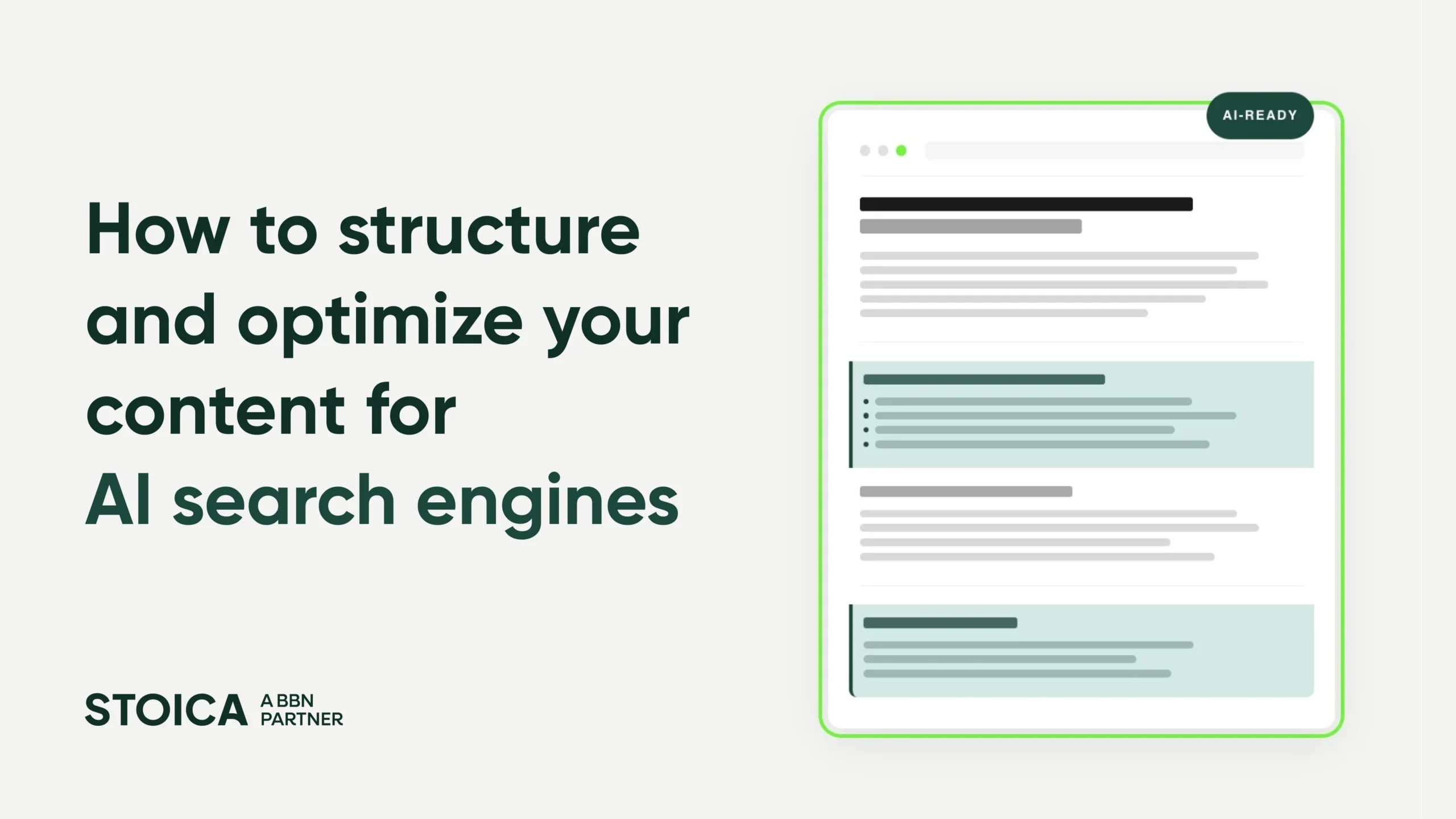
From what we’ve seen, AI systems extract answers more cleanly from structured content than from dense prose. Bullet points, numbered lists, tables, FAQs, and key takeaway boxes all pre-structure information in a format AI can lift directly into a response.
A few specific elements worth building into every article:
- TL;DR at the top. Keep it under 100 words, bullet format, bolded key phrases. Provides a pre-packaged distillation that AI search engines can extract immediately.
- Key takeaway boxes. One per major section, answering the section’s core question in two to three sentences.
- FAQ at the bottom. Treat each answer as a standalone response, not continuation of earlier sections.
- Tables. Tables work well when the structure is simple and flat. Complex or multi-column tables may serialize poorly when AI models ingest raw HTML. We’ve seen flat, simple tables perform more predictably across platforms.
Regarding FAQs, we use them a lot to incorporate specific, long-tail keywords or prompts. The secret is to really think of that FAQ exactly as the user asks it – provide a clear answer to their problem and, when relevant, include your brand’s point of view or relevant numbers to back it up.
Write clearly: specific language, short paragraphs, no fluff
AI systems thrive on clarity and struggle with ambiguity. Short, declarative sentences. Brief paragraphs of two to four sentences. Concrete claims instead of vague language like “innovative,” “next-gen,” or “best-in-class.”
A few habits that matter more than most writers realize:
- Name entities explicitly. Pronouns like “it,” “this,” or “that” lose their meaning when an AI extracts a single sentence out of context. If you’re referring to a product, platform, or concept, name it every time.
- Replace vague time references with specific dates. “Recently” tells an AI system nothing useful. “In Q1 2025” does.
- Replace abstract statements with specific outcomes. “Improves customer experience” is interchangeable with every competitor’s content. “Reduced customer service handling time from 10 minutes to 20 seconds” is specific enough to cite.
Add what AI can’t generate: expert POV, examples, data, and real experience
Generative AI can summarize the internet. It cannot generate original thought, lived experience, or proprietary product framing. This is where content either differentiates or blends in, and it’s the authority layer that makes accessible content worth citing rather than just findable.
We’ve seen this pattern clearly in client work. A first draft that covers all the right topics but relies on the same public framing as every competitor: general claims, no specific product context, nothing a reader couldn’t find elsewhere, doesn’t stand out.
When we revised anarticle for a B2B AI platform client to introduce their specific product framing, framing that wasn’t present in any competitor article, the article consistently outperformed the original across all target keywords, and started ranking for both a TOFU keyword and a BOFU one.
Build topical authority with content clusters and internal links
A single well-optimized article isn’t enough. The working assumption, and one consistent with how RAG-based systems evaluate sources, is that AI platforms assess topical depth from the full body of content on a site, not just individual pages. Related content grouped into clear topic clusters and connected through descriptive internal links signals that you cover a subject area comprehensively rather than opportunistically.
Internal links should use descriptive anchor text. It reinforces topical relationships for crawlers indexing your cluster, and mirrors the relevance signals that correlate with AI citation. Branded, specific anchor text tends to perform better than generic labels like “read more”. They reinforce topical relationships for crawlers and mirror the relevance signals that correlate with AI citation.
Key Takeaway
The structural decisions that matter most, such as where the answer sits, how sections are bounded, how headings are framed, how clearly entities are named, are also the easiest to get wrong because they run counter to how most people are taught to write. Good prose builds to a conclusion. AI-ready content leads with one.
What are the main content mistakes that hurt AI search visibility?
Most of these come down to one root cause: writing for readers who read linearly, not for systems that extract selectively.
- Burying the answer. Opening sections with context, background, or anecdotes before the actual answer is the most common mistake.
- Vague headings. “Overview,” “Background,” “More context”. These tell AI systems nothing about what the section answers. Every heading should signal a specific question.
- Mixing intents in one article. An article that covers content optimization and technical AI search optimization simultaneously will rank clearly for neither.
- Unsupported claims. Vague authority signals like “industry-leading” or “best-in-class” without specific evidence reduce credibility for AI systems evaluating trustworthiness.Name entities explicitly, anchor claims in measurable facts, and replace “recently” with specific dates.
- Hiding key content. AI systems may not render content hidden in tabs or expandable menus, and PDFs often lack the structured signals that HTML provides. If a key answer is buried in an accordion or sitting in a PDF, it may not be parsed at all.
- Generic coverage without original insight. Accessible structure without authority is commodity content. AI systems are less likely to cite your page over dozens of others covering the same ground in the same way. The original editorial layer: your examples, your product framing, your client outcomes, is what makes the difference.
Checklist: how to structure content for AI search engines
These are the things we always try to check before publishing. No checklist guarantees citation, but missing these consistently works against you.
- Does every H2 open with a direct answer in the first one to two sentences?
- Are headings phrased as specific questions, not vague topic labels?
- Does each section work as a standalone unit without requiring context from adjacent sections?
- Is there a TL;DR at the top?
- Are key takeaway boxes present at the end of important sections?
- Is there a FAQ section at the bottom, with clear and concise answers?
- Is every statistic sourced and dated?
- Is original editorial content, client examples, specific product framing, internal observations present in the sections where competitors are most generic?
If you want your brand to show up in AI-generated answers, whether that’s Google AI Overviews or tools like ChatGPT and Perplexity, so clients can find you when evaluating options, let’s chat!