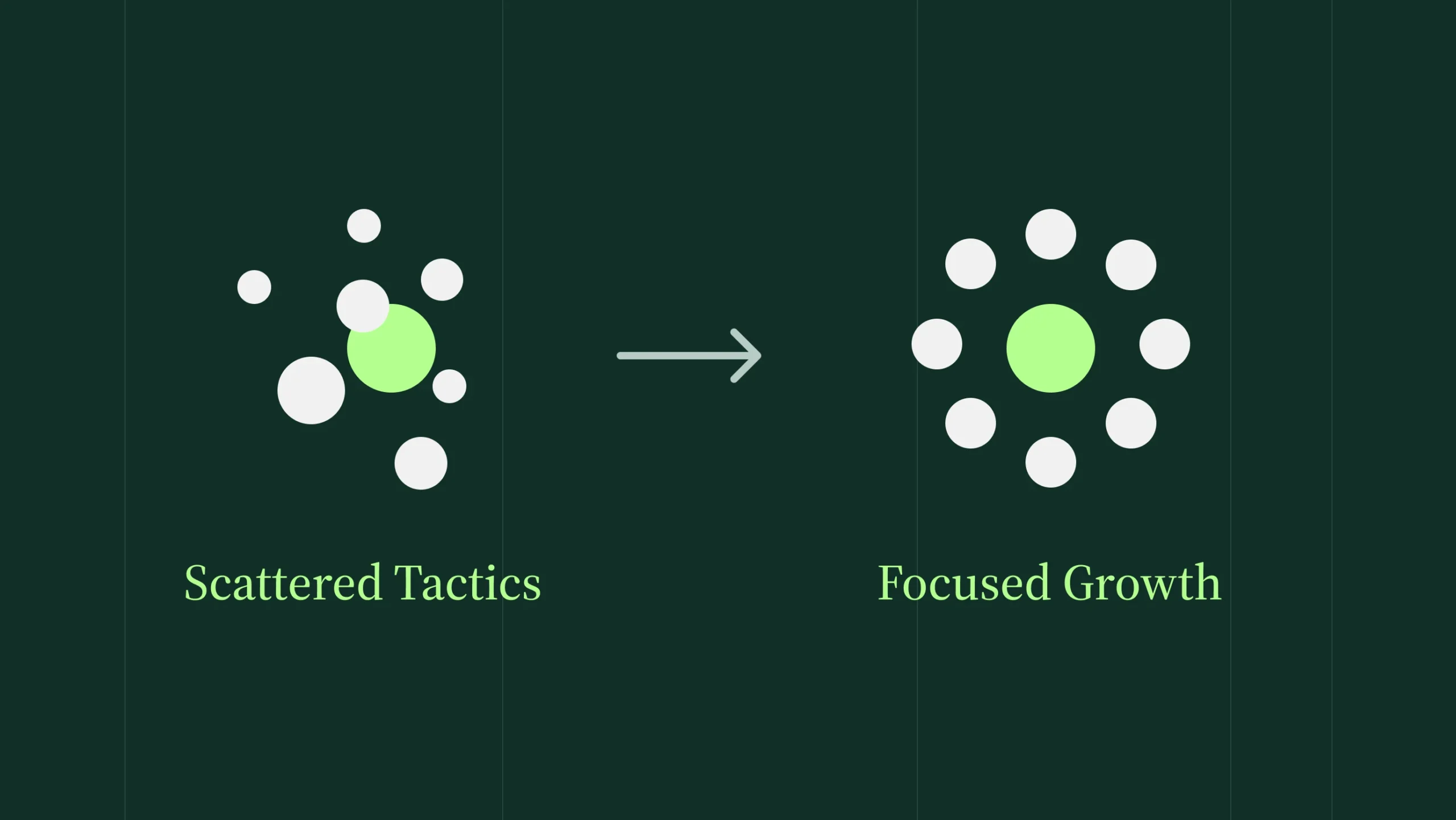
Are you tired of marketing experiments that yield no results? Has your B2B company invested in tactics without seeing meaningful progress? You’re not alone.
For tech-driven companies, especially those with high revenue, getting stuck in their growth is frustratingly common. Your competitors are gaining ground while your efforts stall, leaving you wondering what’s missing in your approach.
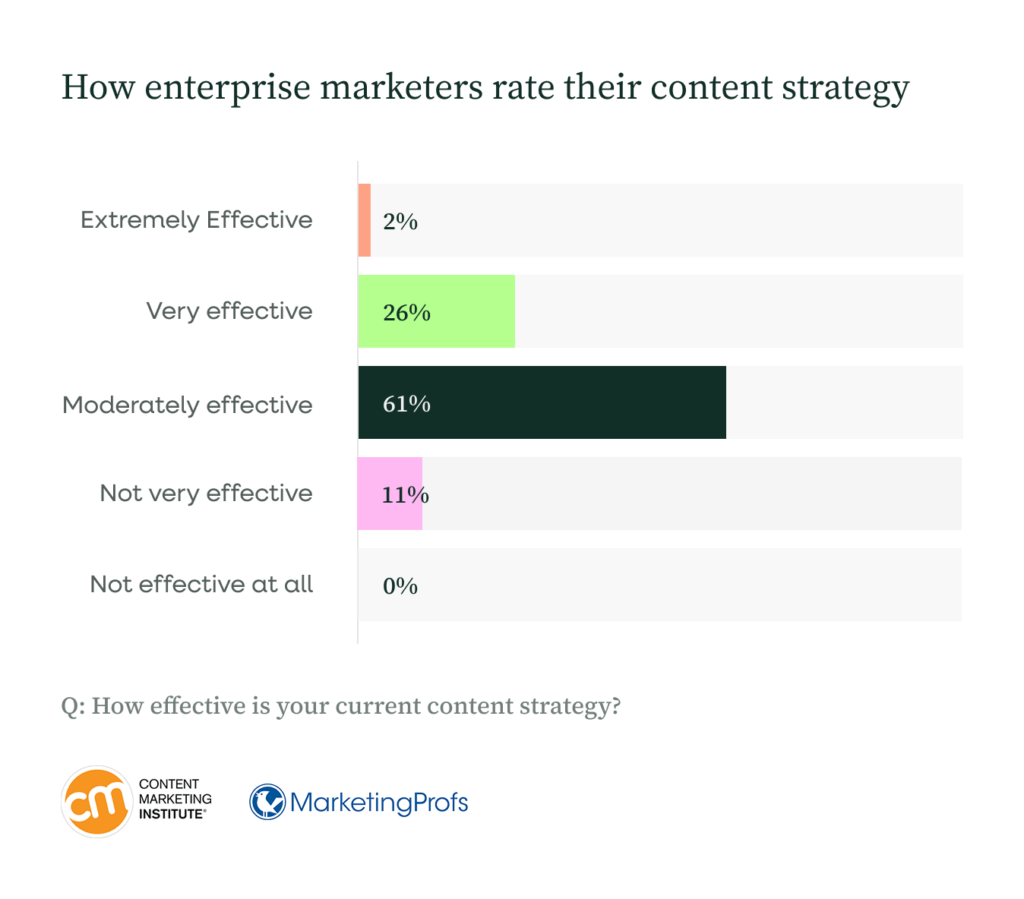
Only 26% of B2B marketers rate their content strategies as “very effective” in 2025. What’s driving this dissatisfaction? No clear goals, inadequate research, and strategies that aren’t tied to the customer journey.
In our 10 years of helping B2B businesses grow, we’ve encountered these challenges repeatedly, and we know how to address them effectively.
Table of contents
1. Why most B2B marketing strategies fail
2. The foundations of an effective B2B marketing strategy
3. Building your B2B digital marketing framework
4. Understanding the B2B buyer’s journey in technology industries
5. Creating a B2B content marketing strategy that converts
6. Lead generation strategies for B2B companies
7. Marketing strategies for tech companies
8. Innovative B2B marketing campaign approaches
9. B2B marketing trends and future outlook
10. How to integrate AI in your B2B marketing strategy
12. Conclusion: From strategy to sustainable growth
13. FAQs about B2B marketing strategy
What you’ll learn in this B2B marketing strategy guide
This comprehensive guide will walk you through the essential components of building an effective B2B marketing strategy that drives sustainable growth for your business.
You’ll discover:
- Why most B2B marketing strategies fail (and how to avoid these common pitfalls)
- The framework for developing a marketing strategy that connects directly to business outcomes
- How to build a digital marketing approach specifically for B2B tech companies
- Content strategies that move complex buying committees toward decisions
- Lead generation techniques that are in tune with your sales process
- Methods to measure marketing performance that executives will understand and value
Whether you’re a Marketing Director, CEO, or decision-maker in a tech-driven company, this guide provides the strategic foundation you need to transform your marketing from a cost center to a growth driver.
1. Why most B2B marketing strategies fail
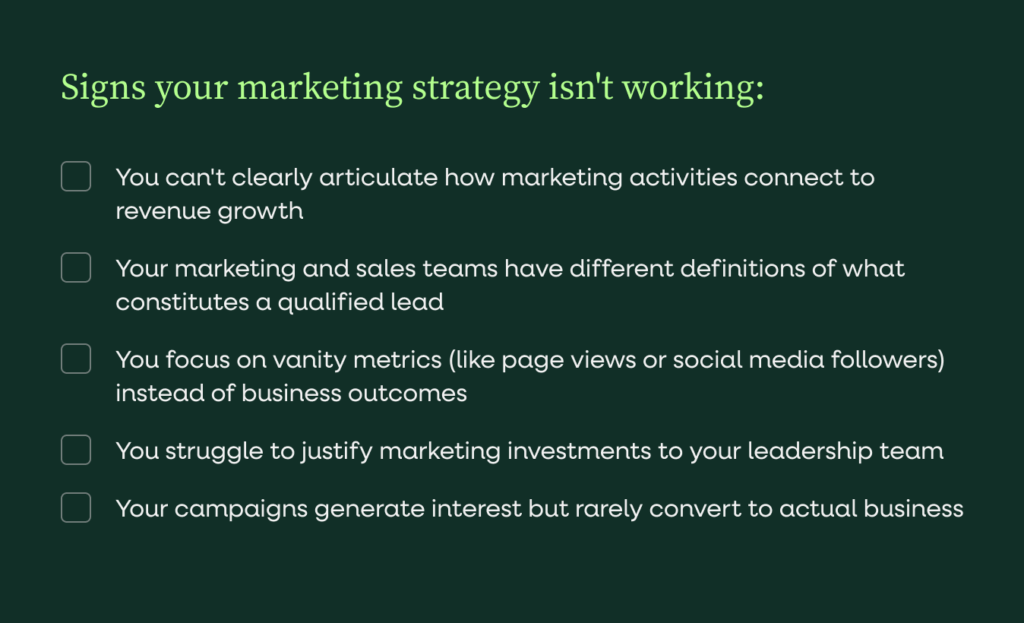
The scenario is all too familiar: a company invests in the latest marketing tactics this quarter, such as account-based marketing, LinkedIn advertising, or a website redesign. After several months and tens of thousands of euros spent, the results are underwhelming. So they try something else, and the cycle continues.
The disconnect between marketing and business goals
One of the primary reasons B2B marketing strategies fail is the disconnect between marketing activities and business objectives. When marketing operates in its own silo, separate from sales goals and company vision, even well-executed tactics fall short.
Case study: How Wirtek broke the tactical loop
When Wirtek, a Danish IT services provider with over 20 years of experience, found that their outbound sales were becoming increasingly costly and inefficient, they needed a new approach. After conducting ideation workshops, client interviews, and developing detailed buyer personas, we created personalized content and nurturing workflows that matched the stages of their customers’ journey.
By aligning marketing activities with business objectives and building processes around their ideal clients’ needs, we helped Wirtek create a sustainable growth system that continues delivering results:
- Organic traffic increased from 14% to nearly 37%,
- Inbound leads tripled,
- Marketing-qualified leads grew 10 times over two years.
This strategic shift reduced their dependence on outbound tactics and created a sustainable marketing growth engine that consistently delivers qualified leads to their sales team.
Check out the entire case study here.
2. The foundations of an effective B2B marketing strategy
Defining marketing strategy vs. marketing tactics
Many B2B companies confuse tactics with strategy. This confusion costs them tens, if not hundreds of thousands in wasted budgets and missed opportunities.
A marketing strategy is your clear plan that defines how you’ll achieve your business objectives through marketing. It answers the “why” and “what” behind your marketing efforts.
Tactics, on the other hand, are the specific actions, channels, and campaigns you use to execute your strategy.
When tech companies jump straight to tactics without a solid strategy foundation, they create what we call “random acts of marketing” or “scattered tactics”: disconnected activities that might bring short-term results but fail to create sustainable growth.

The essential components of a successful B2B marketing framework
An effective B2B marketing strategy framework consists of five interconnected elements:
1. Market definition and positioning
This involves deeply understanding your target market, competitive landscape, and establishing your unique positioning. This means defining:
- Target market segments: Which specific industries, company sizes, and geographical regions offer the best opportunity?
- Competitive advantage: What unique value do you offer that competitors don’t?
- Positioning statement: How do you want to be perceived in the marketplace?
2. Customer understanding
B2B tech purchases involve multiple stakeholders and complex buying journeys. Your framework must include:
- Buyer personas: Detailed profiles of key decision-makers and influencers
- Buying committee mapping: Understanding how decisions are made in your target companies
- Customer journey mapping: Documenting the path from awareness to decision
3. Value proposition and messaging
Your framework needs a clear articulation of:
- Core value proposition: The primary benefit you deliver
- Messaging hierarchy: How you communicate different aspects of your value
- Proof points: Evidence that supports your claims
4. Channel strategy
This outlines where and how you’ll reach your audience:
- Channel selection: Which marketing channels align with your audience’s behavior
- Channel prioritization: Where to invest resources for maximum impact
- Channel integration: How different channels work together
5. Measurement framework
How you’ll track effectiveness:
- KPIs: The specific metrics that indicate progress
- Attribution model: How you assign credit for conversions
- Reporting structure: How insights are shared across the organization
The marketing-sales alignment imperative
Perhaps the most critical foundation of B2B marketing strategy is alignment with sales. Without it, even brilliant marketing strategies will fail. Misalignment between these two departments costs companies at least 10% of their annual revenue, while those where sales and marketing work together experience a 20% annual growth rate.
3. Building your B2B digital marketing framework
Today’s B2B buying process happens predominantly online. Gartner research shows that B2B buyers spend only 17% of their purchase journey meeting with potential suppliers; the rest happens through digital channels.
For tech companies, digital channels have become non-negotiable because:
- Your customers research solutions extensively before engaging with sales
- Digital content supports complex technical evaluations
- Global specialized audiences can be reached efficiently
- Performance can be measured and optimized with precision
Key components of a digital B2B marketing strategy
An effective B2B digital marketing framework includes:
- Digital infrastructure – Your website, marketing automation, CRM integration, and analytics tools form the foundation of your digital presence.
- Content strategy – Content mapped to buyer journey stages, from thought leadership to technical documentation to sales enablement materials.
- Search visibility – With most B2B journeys starting with search, a comprehensive SEO strategy targeting technical and business terms.
- Digital advertising – Strategic paid promotion that accelerates results when focused on qualified reach.
- Social media strategy – Professional platforms that offer targeted reach to decision-makers.
- Email marketing – Direct nurturing of prospects through segmented, automated workflows.

Balancing organic, paid, and traditional approaches
A comprehensive B2B marketing strategy requires the integration of multiple channels, including both new and traditional ones. Successful companies balance paid digital efforts (providing immediate visibility, but requiring ongoing investment) with organic strategies (delivering long-term value, but taking time to build.)
Remember that digital doesn’t replace traditional B2B marketing; it enhances it by connecting physical events with digital engagement, equipping sales teams with digital insights, and supporting account-based strategies with targeted experiences. This integrated approach ensures all marketing activities work together to support your highest-value opportunities.
For example, according to our research from the B2B Marketing Trendbook, live events are making a comeback. The post-pandemic landscape has renewed interest in in-person gatherings, but building an audience requires more effort.
4. Understanding the B2B buyer’s journey in technology industries
The B2B buying process has transformed dramatically. Today’s tech purchases involve an average of 6-10 decision-makers, each bringing different priorities and concerns to the table. Purchase decisions take longer than before, as technical evaluators have gained significant influence, economic buyers enter the process later but hold veto power, and risk concerns have heightened.
Creating accurate buyer personas for complex sales
Generic personas no longer suffice for complex B2B technology sales. Effective personas must capture both role-based insights (functional responsibilities, decision-making authority, success metrics) and psychographic elements (information on consumption preferences, risk tolerance, internal political considerations).
The most effective B2B companies develop interconnected persona sets that map the entire buying committee rather than treating each persona in isolation.
Mapping the B2B buyer’s journey in technology industries
Tech purchase journeys rarely follow a linear path, but understanding the general progression is crucial:
1. Problem recognition stage
- Prospect experiences pain but may not have defined the solution
- Focus on education about problems and implications
2. Solution exploration stage
- Prospect defines solution categories and begins research
- Comparison content and high-level capabilities matter
3. Requirements building stage
- Formal or informal criteria development begins
- Technical specifications and integration details matter
4. Supplier selection stage
- Shortlisting and in-depth evaluation of options
- Proof points, references, and risk mitigation matter
Your marketing plan must include content and engagement strategies for each stage, recognizing that different members of the buying committee may be at different stages simultaneously.
| Top-of-funnel | Middle-of-funnel | Bottom-of-funnel |
|---|---|---|
| Blog posts | Educational resources | Demos and trials |
| Social media posts | Webinars | Consultations |
| Checklists | Case studies | Customer stories |
| Educational webinar | Product presentations | Events |
| How-to-video | Comparison charts | |
| Downloadable kits | Client testimonials | |
| Newsletters | FAQ list | |
| Podcasts |
5. Creating a B2B content marketing strategy that converts
Content marketing for B2B tech companies requires a fundamentally different approach than general content creation. Rather than producing high volumes of surface-level content, a successful B2B content strategy focuses on depth, expertise, and direct business impact.
The core principle is simple: every piece of content should serve a specific purpose in moving prospects through your sales process.
Content mapping for complex sales cycles
Complex B2B sales require content that addresses different stakeholders at various stages of their decision process. Content mapping helps by identifying:
- What information does each buying committee member need at each stage
- Which content formats will be most effective for different purposes
- Where gaps exist in your current content library
For example, a technical decision-maker in the evaluation stage needs detailed implementation information, while a financial stakeholder in the same stage needs ROI models and pricing structures.
Building authority through thought leadership content
In technical B2B markets, establishing authority is crucial. The most effective thought leadership approaches include:
- Original research that reveals meaningful patterns in your industry
- Executive viewpoints on industry trends and business implications
- Technical expertise that helps prospects understand complex topics
The key differentiator between mediocre and exceptional thought leadership is specificity: Generic observations add little value in sophisticated B2B environments.
If you want to learn more about social selling, a concept where thought leadership plays an important role, check out our podcast with Claudiu Jojatu from Milk and Cookies Studio.
6. Lead generation strategies for B2B companies
Effective B2B lead generation requires a structured framework that connects marketing activities to revenue. For tech companies with complex sales cycles, this framework must strike a balance between immediate results and long-term relationship building.
Qualifying and converting leads
In B2B technology marketing, lead quality trumps quantity. The most valuable qualification signals combine:
- Direct indicators from prospects (form responses, demo requests)
- Behavioral patterns (content engagement, visit frequency)
- Company-level factors (industry alignment, technology environment)
Effective lead conversion requires clear alignment between marketing and sales through defined qualification criteria, service level agreements, lead routing logic, and closed-loop feedback.
Nurturing strategies for long B2B sales cycles
The reality of complex B2B sales is that many qualified prospects won’t be ready to buy immediately. Effective nurturing keeps these prospects engaged through content-driven approaches that deliver progressively deeper information.
7. Marketing strategies for tech companies
Technology companies face distinct marketing challenges that traditional B2B approaches often fail to address. The complexity of technical products makes them difficult to explain simply without oversimplification, and many tech companies struggle to translate technical capabilities into business benefits.
Other key challenges include:
- Rapidly evolving markets: Tech markets transform quickly, with competitors constantly emerging and customer expectations shifting. Marketing strategies must remain adaptable while maintaining consistent positioning.
- Multiple decision-makers: Tech purchases typically involve both technical evaluators and business decision-makers, each with different priorities. Your marketing must speak to both audiences without alienating either.
- Long sales cycles with technical validation: Enterprise tech sales often include lengthy proof-of-concept phases and technical evaluations. Marketing must support each stage with appropriate content and enablement.
- Post-sale importance: Customer success and adoption have a critical impact on renewal and expansion revenue. Marketing’s job extends beyond acquisition to supporting implementation and ongoing usage.
Building credibility in technical markets
In technical industries, credibility is the currency that opens doors. Building this credibility requires:
- Technical thought leadership through original research and engineering-led content
- Social proof from technical peers through detailed case studies and testimonials
- Transparency about capabilities, including limitations and development roadmaps
Avoid marketing hyperbole that triggers skepticism from technical evaluators. Instead, focus on substantiated claims backed by evidence and specifics.
Product marketing vs. corporate marketing in tech companies
Tech companies require both product marketing and corporate marketing, but confusion between these functions often leads to inefficiencies.
| Product Marketing | Corporate Marketing |
|---|---|
| Defining product positioning and messaging | Overall brand strategy and awareness |
| Creating technical content and sales enablement materials | Corporate communications and PR |
| Supporting product launches and feature releases | Website and digital presence management |
| Competitive intelligence and differentiation | Demand generation campaigns |
| Working closely with product management and sales | Marketing operations and technology |
8. Innovative B2B marketing campaign approaches
Successful B2B marketing campaigns in 2025 are defined by strategic intent rather than tactical experimentation. Some of the most effective approaches include:
- Brand-led demand generation – Building recognition that positions your company in the consideration set before prospects even begin their search
- Zero-click influence marketing – Creating value in spaces where your audience already consumes information, building trust before the formal buying process begins
- Community-powered engagement – Developing micro-communities that foster peer-to-peer connections around your brand
- Data-narrative synthesis – Combining proprietary data insights with compelling storytelling to stand out in information-saturated environments
9. B2B marketing trends and future outlook
B2B marketing stands at a pivotal moment in 2025, with experimental approaches giving way to refined strategies.
Current trends reshaping B2B marketing
- Strategic engagement over experimentation – The era of scattered tactical execution is ending. Today’s successful marketers adopt precision and strategic audience engagement, informed by a deep understanding of their customers.
- Human-AI balance – Top brands find the sweet spot between automation efficiency and authentic human connection. As one expert noted, “Use AI, but correct it based on your professional experiences.”
- Brand influence trumps lead generation – B2B strategy is shifting from transactional lead capture to long-term brand influence. “Make people search for you,” suggests one consultant, advocating for stronger brand recognition.
- Relationship-focused marketing – With many budgets remaining flat, companies are prioritizing high-impact strategies that foster lasting relationships and demonstrate clear return on investment (ROI).
Predictions for the future of B2B marketing
- Zero-click marketing strategies – Creating influence where audiences already spend time—through podcast sponsorships, community engagement, and thought leadership—will become increasingly important.
- Data-led decision-making – The future belongs to marketers who not only collect data but also derive meaningful insights and translate them into practical strategies.
- Cross-functional collaboration – The borderline between marketing and sales continues to blur, with unified approaches creating seamless customer journeys that drive business growth.
If you want to learn more about our trends and predictions for 2025, download the trendbook here.
10. How to integrate AI in your B2B marketing strategy
The integration of AI into B2B marketing has accelerated dramatically, but success lies in finding the optimal balance between automation efficiency and human creativity.
The AI opportunity for B2B marketers:
- Content creation at scale for complex technical topics
- Advanced lead scoring and behavioral analysis
- Personalization across multiple touchpoints and buying committee members
- Predictive analytics for pipeline forecasting
- Automated nurturing sequences that adapt to prospect behavior
The AI paradox in B2B marketing: Over-automation can result in generic, soulless content that struggles to resonate with sophisticated B2B audiences. The most successful tech companies understand that AI should enhance, not replace, the human elements that build trust and credibility.

Best practices for AI implementation:
- Use AI for data analysis and routine content creation while focusing human creativity on strategic thinking and relationship building
- Maintain human oversight for all customer-facing communications
- Leverage AI insights to inform strategy rather than automate decision-making
- Ensure AI-generated content maintains your brand voice and technical accuracy
11. Our A.P.E.X. System™
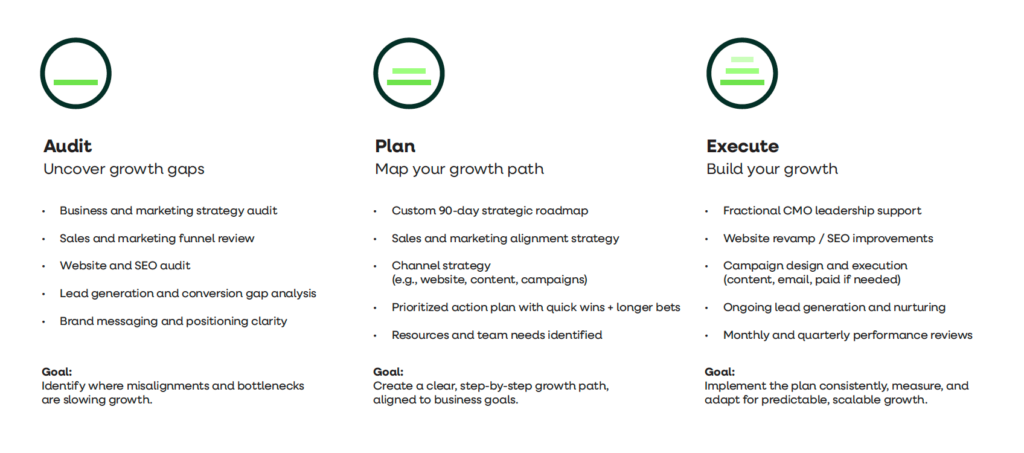
The A.P.E.X System™ is our proven methodology that transforms scattered marketing efforts into focused growth for B2B tech companies. Where many founder-led businesses stall because marketing and business strategy aren’t aligned, our system bridges this gap by both understanding business strategy and executing marketing effectively.
Our approach works through three distinct phases:
1. Audit – Uncovering growth gaps through a comprehensive assessment of your strategy, funnel, website, and messaging.
2. Plan – Mapping your growth path with a 90-day roadmap and prioritized initiatives.
3. Execute – Building your growth system with leadership support, implementation, and continuous optimization.
The result is a transformation from scattered marketing efforts to focused growth initiatives that deliver tangible business outcomes.
12. Conclusion: From strategy to sustainable growth
The difference between companies that struggle with growth and those that achieve sustainable expansion lies in a strategic approach to marketing. By implementing these principles consistently and with focus, your marketing transforms from a cost center to a predictable growth driver for your business.
Ready to get unstuck and transform your marketing approach? Explore our B2B Marketing Strategy Solution to discover how our systematic approach can help your tech company build a marketing system that delivers consistent results.
Book a complimentary strategy consultation directly through our calendar to discuss your specific challenges and see how the A.P.E.X System™ can work for your business.
13. FAQs about B2B marketing strategy
Tech companies are allocating more resources to digital channels and educational content, with product demonstrations replacing traditional sampling and adopting subscription-based pricing models. The most successful tech companies create a balanced marketing mix emphasizing thought leadership, technical validation, and ongoing value demonstration.
International tech marketing requires addressing regional technical specifications, compliance requirements, and implementation considerations. Market maturity varies dramatically across regions, affecting messaging strategy. Successful international tech marketers maintain consistent core technical messaging while customizing business value propositions to regional market conditions.
Lead generation for complex solutions requires technical assessment tools, benchmark reports, technical deep-dive webinars, and developer communities. Success depends on prioritizing the depth of qualification over lead volume and developing separate nurture paths for technical evaluators versus business sponsors.
Key trends include digital-first analyst relations strategies, product-led growth approaches, technical community building, and decentralized content distribution through employee advocacy, as well as increased investment in technical algorithm optimization and immersive environments for complex solution demonstrations.